


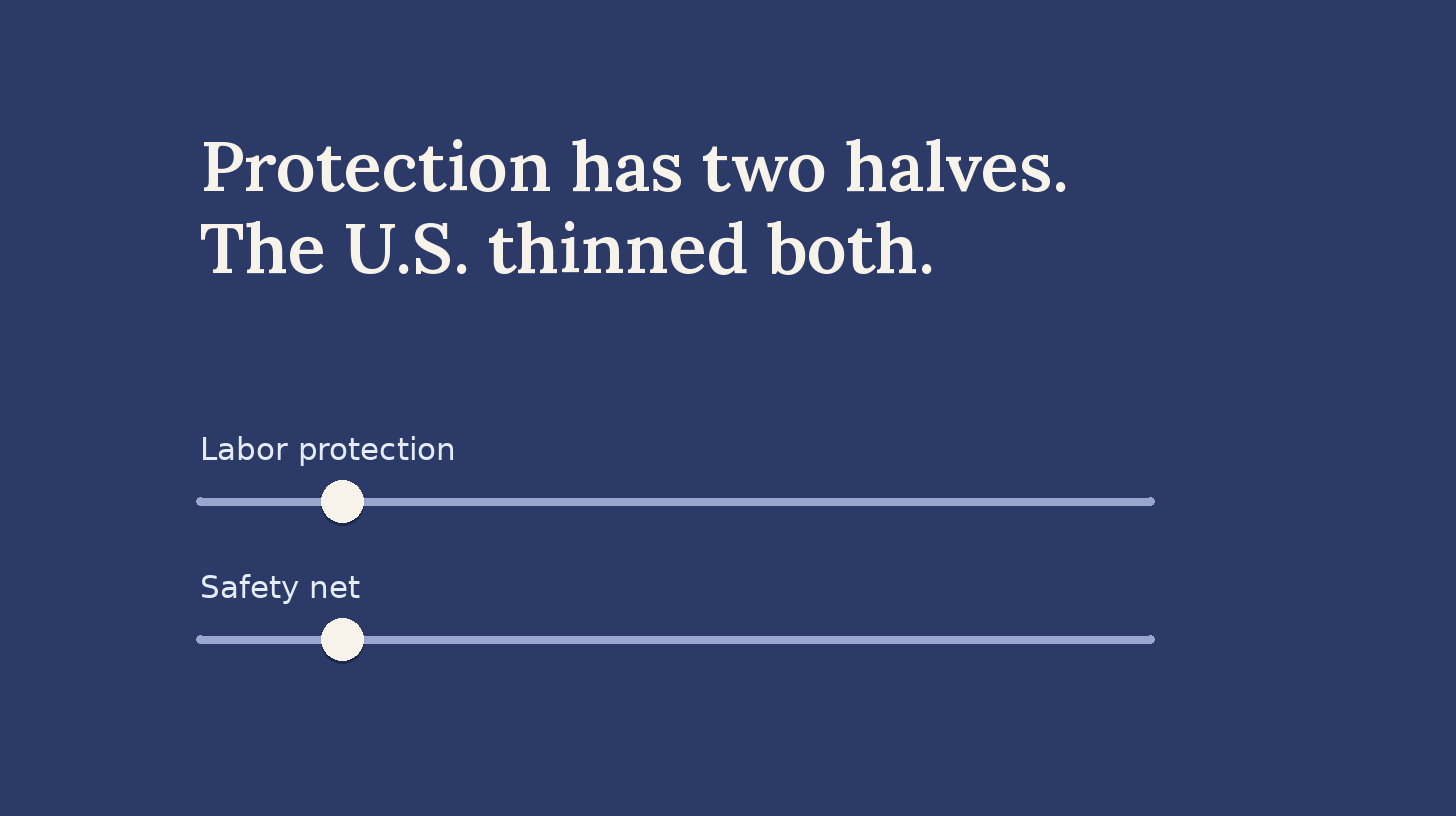
When a job ends, two systems decide how hard you fall: labor law, which can make the job harder to lose, and the safety net, which can catch you once it's gone. In a coherent design they mirror each other — light on one side, heavy on the other. The U.S. went light on both, and the fall lands on you.
Labor law does not work alone. It is one of two interlocking systems that together determine how risk is distributed in an economy. The other is the safety net. The two have to mirror each other to produce a coherent outcome. When they do not, the system produces a particular kind of failure that does not show up in either system on its own.
Labor law and the safety net are two of the most important dials in the architecture of a wellbeing society, and the relationship between them is the one that most determines whether the system works. Design the pair well, and many of the other dials become easier to set. Design them out of relation to each other, and no amount of adjustment elsewhere fully compensates. Each system can be designed well on its own; only their interaction makes a society work.
Two ways to absorb risk
Every employment economy generates volatility. Recessions, restructurings, illness, technological change — all of these produce moments when a worker loses income, or healthcare, or stability. The volatility cannot be wished away. It can only be placed somewhere.
There are two main ways a society can absorb that volatility.
The first is to absorb it inside the employment relationship. Strong dismissal protections, mandatory notice periods, severance requirements, restrictions on layoffs. The worker is shielded because the firm is required to carry the cost of the disruption. The employment relationship is durable, harder to end, and the cost of ending it is paid largely by the employer.
The second is to absorb it outside the employment relationship. The firm can dismiss with relative ease, but when the relationship ends, the worker falls into a system that catches them. Unemployment insurance replaces a substantial fraction of income. Healthcare continues regardless of employment status. Retraining is funded. A new role can be found before savings are exhausted.
These are two different routes to the same destination: a worker whose life is not destroyed by an economic shock. The first route routes the cost through the firm. The second routes it through the collective. Both can work. Both are operating somewhere in the world right now.
What does not work is choosing neither.
The mirror
This is the structural point. Labor law and the safety net are mirrors of each other. They are not separate policy choices; they are two faces of the same allocation.
When labor law is heavy — dismissal is hard and protections are strong — the safety net can be lighter. The firm is already absorbing most of the shock. The collective does not need to step in as forcefully because the cost has been internalized in the employment relationship. Italy and France operate variants of this. Job security is high; unemployment systems exist but do less of the heavy lifting because most workers stay attached to firms across business cycles.
When labor law is light — dismissal is easy and severance is not required, with at-will employment as the default — the safety net must be heavier. The firm has been released from the obligation to absorb the shock. If the collective does not step in, the shock lands on the individual. Denmark, the Netherlands, Sweden operate variants of this configuration. Labor markets are flexible by U.S. standards, and the collective system is correspondingly deep. This is what flexicurity names: flexibility on the labor law side, security on the safety net side, with the two mirroring each other deliberately.
Both configurations distribute the cost of volatility. They do it differently, but they do it. A worker losing a job in either system has somewhere to land.
What the U.S. does
The U.S. configuration is the third option. It is the one that does not work as a coherent system.
The previous essay traced what U.S. labor law looks like: a thin federal framework, with state-level variation that pulls the floor down further in many states. At-will employment is the default. Dismissal is easy and cheap for the employer. The firm has been released from most of the obligation to absorb the shock of ending an employment relationship.
The expectation, if the system were designed coherently, would be a correspondingly deep safety net. Light labor law in one half of the mirror should produce a heavy safety net in the other.
The U.S. safety net is not deep. Unemployment insurance varies by state, with benefit levels and durations that are often low by international standards. Healthcare is largely tied to employment, so the same shock that ends the job often interrupts coverage. Retirement security depends primarily on individual savings accumulated inside the employment relationship. Family support is fragmented. Transition support — retraining, job matching, relocation — exists but is uneven and underfunded compared to peer economies.
The two halves of the mirror do not match. Labor law has been calibrated for maximum flexibility. The safety net has not been calibrated to absorb the consequences. Workers are expected to be flexible without being protected. Adjustment is fast for firms and dangerous for people.
This is not a balance. It is a one-sided absorption of volatility, with most of it landing on the individual worker.
What mismatch produces
Coherent configurations — the heavy-labor-law versions and the heavy-safety-net versions — distribute risk to different actors but distribute it. The U.S. mismatch does not distribute. It funnels.
When the firm has been released from the obligation to absorb the shock, and the collective has not stepped in to absorb it, the shock has to land somewhere. The only remaining place is the individual.
This is not a metaphor. It is mechanical. A laid-off worker in Denmark experiences a serious life event with bounded consequences — income continues, healthcare continues, retraining is available, the next role is supported. A laid-off worker in France experiences a different but also bounded version — the firm has had to cover much of the transition before it happened, the safety net continues afterward. A laid-off worker in the U.S. faces a cascade. Income stops. Healthcare may end or become unaffordable. Retirement contributions interrupt. Housing becomes uncertain. The shock that should have been one event becomes several events in series.
This is what a later essay calls the narrow focal point of employment. The mismatch between thin labor law and thin safety net produces a system in which all of the consequences of an employment disruption flow through one channel, with no parallel system in place to absorb them. The result is a cascade.
It is worth being clear about what the cascade is and what it is not. It is not a failure of compassion. It is not a failure of any particular policy. It is the predictable outcome of a system in which two interlocking pieces have been calibrated independently, without reference to each other. Labor law was made light. The safety net was not made heavy. The arithmetic does what arithmetic does.
Why the mismatch persists
A coherent configuration in either direction — heavy labor law plus light safety net, or light labor law plus heavy safety net — can be defended on its own logic. The U.S. mismatch is harder to defend, but it persists for reasons worth naming.
The political coalitions in the U.S. are not organized around the mirror. One side tends to argue for lighter labor law without addressing what the safety net would need to be. The other side tends to argue for a heavier safety net without confronting the labor-law question. The combination of the two positions is not a coherent design; it is the residue of a political conversation that does not treat them as the same question.
There is also a federalism complication. Federal labor law could be reformed to make dismissal harder; federal safety net programs could be expanded to absorb more risk. Neither has happened at scale in decades. State-level reforms can move the calibration in either direction but cannot change the federal floor. The combination of weak federal action on both halves and inconsistent state action produces the divergence the previous essay described — with the underlying mismatch unaddressed.
There is also a worker-leverage point worth naming briefly. When the safety net is thin, individual workers have little independent leverage against employers. Their bargaining position depends almost entirely on the employer’s willingness to offer terms. This means the costs of the mismatch land on workers who, by design, have the least capacity to push back against the design. The political economy of the situation reinforces the mismatch: those most exposed to it are least able to change it.
The design implication
The argument of this essay is structural. Labor law and the safety net are not separate policy domains. They are two faces of a single allocation of risk, and they have to be designed together.
A society can choose to put more weight on the employer side, by making employment durable and exit costly. A society can choose to put more weight on the collective side, by making the safety net deep enough that ending an employment relationship does not produce a personal crisis. A society can choose somewhere in between, calibrating both halves to mesh.
What a society cannot do, coherently, is calibrate one half for maximum flexibility and the other for minimum cost. That is not a design. It is the absence of one. And the absence has consequences that are not abstract.
A later essay describes what the absence produces in lived experience.
Closing
The mirror is not a metaphor. It is a structural relationship between the two systems that together determine how an economy absorbs the shocks it generates.
When the mirror is coherent — in either direction — a worker losing a job has somewhere to land. The cost of volatility is real but bounded. The economy adjusts and the worker adjusts with it.
When the mirror is broken, the cost lands on the worker alone, and it does not stay bounded. One shock becomes several. Income loss becomes housing instability becomes healthcare interruption becomes long-term economic damage. The cascade is what the U.S. system produces by design, not by accident.
Fixing the mismatch does not require choosing one model over the other. It requires recognizing that the two halves have to be calibrated together — and then making the calibration deliberately, in whichever direction the society wants to go.
The dials in play
Labor protection (rigid ⟷ flexible). The U.S. sets this toward flexible — dismissal is easy and cheap for the employer. Flexibility is not the flaw; flexibility with nothing underneath it is.
Safety-net depth (thin ⟷ deep). Set thin, so the shock the flexible side hands off has nowhere to land. A deep net is what makes a flexible labor market survivable.
Risk allocation (individual ⟷ firm ⟷ collective). The master dial, and what this essay is really about: when both halves of the mirror are set light, the cost lands on the individual — not by anyone’s choice, but by arithmetic.
What to ask your representatives
Instead of asking whether we should make firing harder, ask: if dismissal stays easy, how deep does the safety net have to be to match it?
Instead of asking how to trim unemployment spending, ask: when a job ends here, where does the cost actually land, and on whom?
Instead of debating labor law and the safety net as separate fights, ask: are we calibrating the two halves together, or leaving a gap the worker falls through?