


The United States does not have one labor system. It has fifty, sharing a thin federal floor. What your employer owes you — paid leave, notice, protection when work ends — depends mostly on which state you work in.
The previous essay described what labor law is for and how different societies calibrate it. This one turns to a specific case: the United States.
The U.S. is unusual among large economies in how it distributes labor law authority. National frameworks in most peer countries set substantive protections that constrain employers and protect workers across the whole country. The U.S. national framework does much less. It establishes a floor and lets the states build whatever they want on top of it. The result is not one labor system but fifty, sharing only a thin federal foundation.
This essay walks through what that federal floor actually contains, what it leaves out, and what different states have built above it. Three state cases illustrate the range.
What U.S. federal labor law does
Federal labor law in the U.S. is a relatively thin framework. It establishes a minimum wage, currently low by international standards. It mandates overtime pay for many workers. It sets basic workplace safety rules through the Occupational Safety and Health Administration. It prohibits certain forms of discrimination. It guarantees a formal right to organize, with significant practical constraints.
What federal law does not do is at least as important as what it does. It does not guarantee paid vacation. It does not guarantee paid sick leave. It does not guarantee paid parental or family leave. It does not require notice before dismissal in most circumstances. It does not require severance. It does not require predictable scheduling. It does not establish broad job-protection rights.
The phrase most often used to describe this configuration is at-will employment. Most U.S. workers can be terminated by their employer at any time, for any reason that is not specifically illegal, without notice or cause. Most U.S. workers can also quit at any time, which is presented as the symmetric counterpart. The symmetry is technical. In practice, the cost of being terminated and the cost of quitting are not the same, because what the worker loses on termination usually includes healthcare access, retirement contributions, and other security routed through the employment relationship.
At-will is presented as a default — the way labor relationships naturally work in a free economy. It is not. It is a particular legal choice, made by U.S. federal and state law and reaffirmed repeatedly over more than a century. Most peer economies make a different choice. The fact that the U.S. did, and continues to, is itself an allocation of risk.
Federal labor law in the U.S., in other words, is mostly the floor. It establishes what an employer cannot do. It does not establish much about what an employer must do.
The real action is at the state level
Because the federal floor is low, the variation that matters in U.S. labor law happens at the state level.
States set their own minimum wages, often substantially above the federal floor. States decide whether paid sick leave is mandatory. States decide whether paid family leave exists and how it is funded. States decide what additional anti-discrimination protections apply. States decide whether non-compete clauses are enforceable. States decide unemployment insurance benefit levels, duration, and eligibility. States decide how aggressively to enforce wage-and-hour rules. States decide whether to allow union security agreements in unionized workplaces — the right-to-work question.
The result is not experimentation around a shared standard. It is structural divergence.
Two workers doing identical jobs for the same employer can face very different levels of protection depending on which state they work in. The leverage they hold against the employer differs. The cost of being fired differs. The cost of being injured differs. The cost of having a child differs. The same federal floor underpins all of it, but the floor is low enough that the state choices dominate the actual experience.
This is not a small variation. The gap between the most protective U.S. states and the least protective is wider than the gap between most European countries’ labor systems. The U.S. has not designed one labor system. It has designed fifty different calibrations on top of a thin federal foundation.
Three state cases make this concrete.
California: stacking protection above the federal floor
California operates the most worker-protective labor regime in the United States.
The state minimum wage is significantly above the federal floor and rises annually with inflation. Several large sectors operate under higher sector-specific minimums, with fast-food workers and healthcare workers among the most recent additions. Paid sick leave is mandatory. Paid family leave exists through a state-funded program. The state has strict wage-and-hour enforcement, with significant penalties for misclassification and wage theft. Non-compete clauses are generally unenforceable. The state’s worker-classification law made it substantially harder to classify workers as independent contractors rather than employees, which has consequences for whether those workers are covered by labor protections at all.
The overall configuration approximates a European-style state-level safety layer on top of the federal framework. California has, in effect, built much of what the federal government chose not to. The trade-off is real — California is more expensive to operate in for many employers, and the state’s labor compliance environment is complex — but the protection it gives workers is substantially closer to what peer economies guarantee.
States with directionally similar approaches include New York, Washington, Oregon, and to a slightly lesser extent New Jersey and Massachusetts. Each calibrates differently, but the family resemblance is clear: high state minimums, mandatory paid leave of various kinds, active wage enforcement, restrictions on non-competes.
Texas: the federal floor as the ceiling
Texas operates near the opposite end.
The state minimum wage equals the federal minimum, which has not risen since 2009. There is no state mandate for paid sick leave; cities that have tried to mandate it have been preempted by the state. There is no state-funded paid family leave program. Texas is a right-to-work state, which constrains union security agreements. Wage enforcement is light. Non-compete agreements are enforceable under broad conditions. Unemployment insurance benefits are among the lowest in the country in both level and duration.
The overall configuration is to make the federal floor effectively the ceiling — to add as little additional protection at the state level as possible, and in some cases to actively prevent localities from adding protection of their own.
The argument for this configuration is that lighter regulation produces a more competitive business environment, attracts capital and jobs, and grows the economic pie. The evidence for this argument is mixed but real — Texas has attracted significant in-migration and business relocation over the past two decades. The cost is borne by workers, who face the steepest version of the U.S. design: thin federal protection, thin state protection, and an employment relationship that carries most of their security.
States with directionally similar approaches include Florida, Tennessee, Georgia, South Carolina, and Alabama. These states share a low state minimum, no or minimal paid leave mandates, right-to-work statutes, and broadly enforceable non-competes.
Massachusetts: buffering without rigidity
Massachusetts operates a third kind of calibration that is worth naming because it is neither California nor Texas.
The state pioneered the healthcare-access reform that became the model for the federal Affordable Care Act. Massachusetts residents have access to subsidized health insurance largely decoupled from employment, which substantially reduces one of the core risks the federal architecture stacks on the employment relationship. The state has a relatively high minimum wage, mandatory paid sick leave, and a paid family and medical leave program funded by a state payroll tax. Non-competes are enforceable but with meaningful limits.
At the same time, Massachusetts is not as aggressively interventionist on labor regulation as California. Strict worker-classification rules, which in California have reshaped whole sectors, do not apply in the same way. The state’s wage enforcement, while real, is less expansive. Labor-market flexibility is closer to the national norm than to California’s.
The result is a configuration sometimes described as buffering without rigidity. The most consequential risks — healthcare, family disruption — are softened by state-level institutions that operate independently of any particular employer. Labor markets themselves remain relatively flexible. The trade-off is closer to what the wellbeing-oriented economies of northern Europe operate, where high adjustment speed coexists with substantial collective buffering.
States with directionally similar approaches include Connecticut, Rhode Island, Maryland, and Minnesota. Each has a version of the same logic: build state-level protection on the things that matter most for security, without making the labor market itself maximally rigid.
Three calibrations, one country
Three states. Three different calibrations of the same federal framework. Three different distributions of leverage between workers and employers.
It is worth pausing on what this means. The same federal labor law applies in all three. The same federal floor underpins each. The variation is entirely above the federal level. A worker who moves from Texas to California crosses what is, in effect, a different labor system, without changing countries.
This is not how labor law works in most peer economies. National frameworks are stronger; subnational variation operates within tighter bounds. The U.S. design pushes the consequential choices down to the state level and accepts the divergence that results. The political effect is that workers cannot meaningfully appeal to a national standard when their state has made a punitive choice — because there is no national standard above the floor to appeal to.
A later essay turns to what happens when this configuration interacts with the safety net, which in the U.S. is also fragmented and state-administered.
Closing
The U.S. labor system is not one system. It is fifty calibrations sitting on top of a federal floor that does much less than peer-country baselines.
This matters because the choices made above the floor are consequential. They determine how much leverage a worker has, how much risk falls on them when work ends, and whether the cost of being in this country’s labor market is bearable or punitive. The state cases above are not endorsements or warnings. They illustrate the range.
What is striking about the U.S. configuration is not that it produces divergence. It is that the divergence is real enough that workers experience meaningfully different labor systems within a single country — and that the choice of which one applies to them is mostly a matter of where they happen to live.
The dials in play
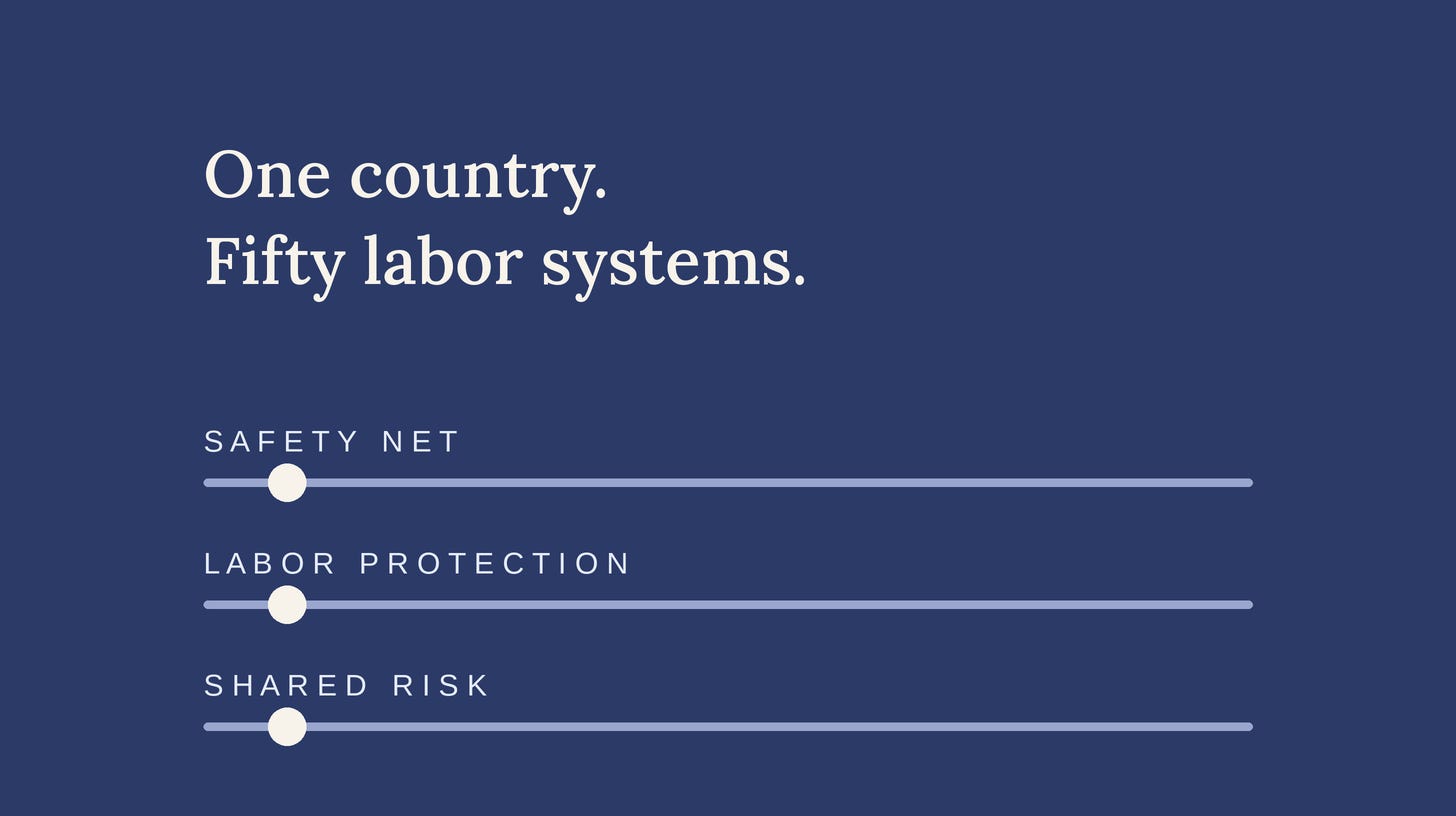
Labor protection (rigid ⟷ flexible) — in the U.S., the federal level sets this dial near the flexible end and leaves the rest to the states. California turns it back toward protection; Texas leaves the federal floor as the ceiling. Every state holds the same dial — what differs is how far each has chosen to move it.
Safety-net depth (thin ⟷ deep) — paid sick days, family leave and unemployment benefits are state choices built on a thin federal base. Toward deep: a job loss is a survivable transition. Toward thin: the same job loss cascades into lost income, lost coverage and lost footing. Which one you get is decided by your address.
Risk allocation, the master dial (individual ⟷ firm ⟷ collective) — the federal design places the cost of ending work on the individual; how much of it a state lifts off again is the real difference between the fifty calibrations.
What to ask your representatives
Instead of asking what U.S. labor law guarantees, ask: what does my state add above the federal floor — paid sick days, family leave, unemployment benefits that hold — and what has it chosen to leave out?
Instead of asking whether worker protection costs jobs, ask: which states have paired flexible labor markets with real buffers, and what happened to their economies?
Instead of directing every labor question at the federal level, ask: these settings are state choices — which of these dials will my state representatives move, and which will they leave at the floor?