


Risk is usually framed as something that happens to a person.
A job ends. An illness arrives. A child is born. A career closes. The conversation that follows is almost always about how the person should have prepared — savings, insurance, planning, prudence. The unit of analysis is the individual, and the question is how well they absorbed the shock.
This framing misses what is actually happening.
The shock is real, but its weight is not fixed. Every economy produces volatility, and every society has already made decisions about who carries it. The person experiencing the consequence is rarely the person who decided where the consequence would land.
Risk does not happen to people in a vacuum. It is allocated.
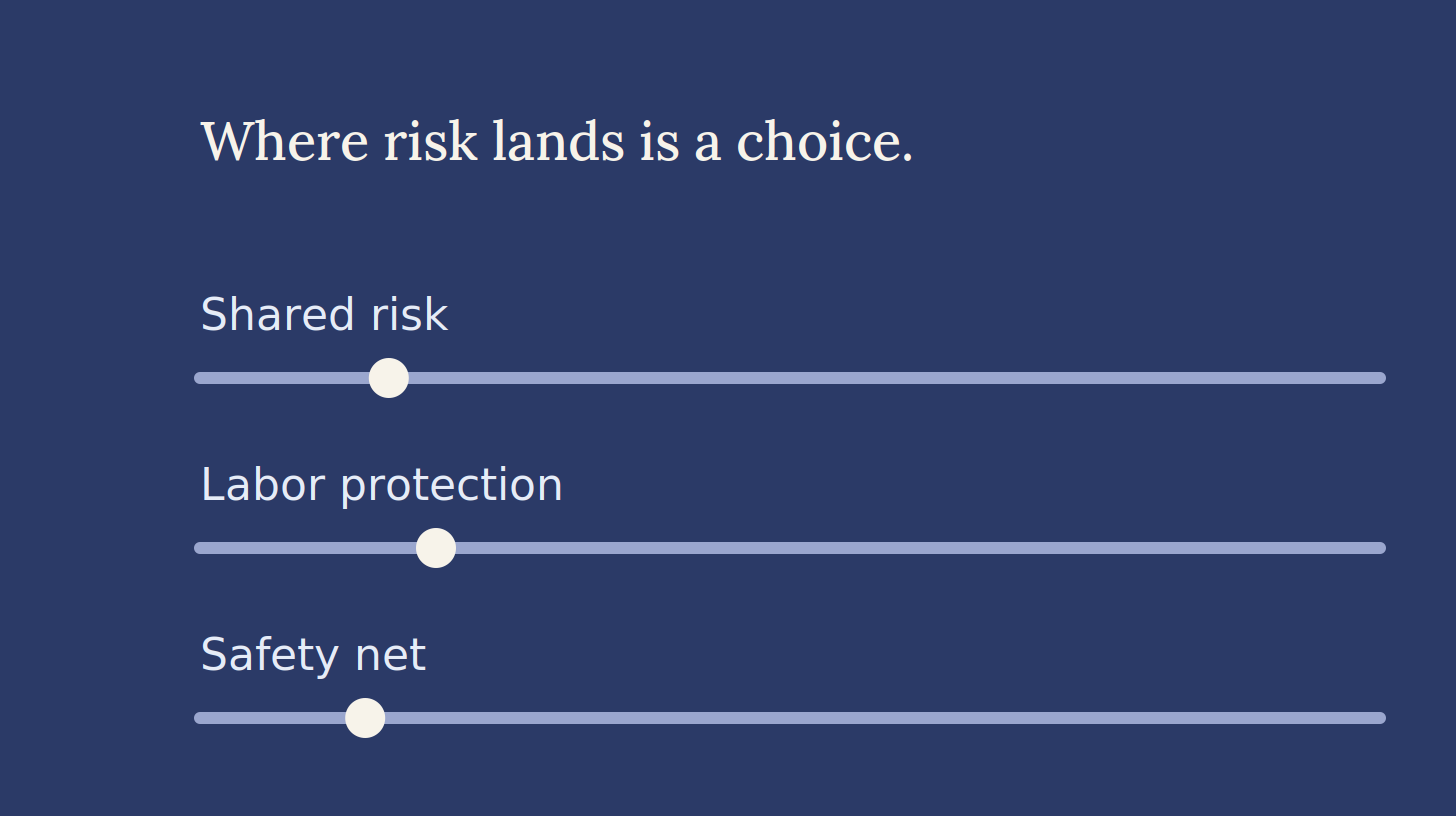
Three places risk can land
In any economy, when something goes wrong, the cost has to be absorbed somewhere. There are three places it can go.
It can land on the individual. The person loses their income, their healthcare, their housing security or their retirement accumulation. They are expected to have prepared, and if they did not, the consequence is theirs.
It can land on the firm. The employer continues paying wages during a downturn, retains workers through illness, finances parental leave, carries the cost of restructuring rather than passing it on.
It can land on the collective. Society as a whole — through public insurance, transfers, services or shared infrastructure — absorbs the shock and spreads it across the population and across time.
No economy uses one of these exclusively. Every economy uses all three. What differs is the mix.
The mix is not chosen directly. There is no single lever or policy in any legislature called “risk allocation.” The placement falls out of several choices — how laws govern hiring and firing, what protections follow a person between jobs, how shocks are absorbed when they arrive, what support exists for people moving between roles. These are the dials that actually get turned. Where risk ends up is the result.
That is what makes risk allocation worth naming. The dials are usually debated separately, as if each were its own question. The placement is what they add up to.
The same shock, different lives
The clearest way to see this is to follow a single event through different systems.
Take job loss. In one country, losing a job means losing income, healthcare and the structure of daily life within weeks. The person carries the full weight of the transition — finding new work quickly, often for less, while managing the disappearance of protections that were tied to the job. In another country, the same job loss triggers unemployment insurance that replaces most of the income, healthcare that continues uninterrupted, and access to retraining funded by the state. The person is still unemployed. The shock is still real. But it lands on a different actor.
Take illness. In one system, a serious diagnosis can end a career and consume household savings. In another, treatment is provided regardless of employment, and income continues through statutory sick leave. The illness is the same. The trajectory afterward is not.
Take the arrival of a child. In one system, parents pay for childcare out of pocket, take unpaid leave or return to work within weeks because otherwise they would lose their jobs. In another, parental leave is paid for a year or more, childcare is publicly financed and parents can flexibly organize their working hours for the first years. The biological event is identical. The economic event is structured by entirely different choices about who carries the cost.
The same shock produces different lives. The difference is not the shock. It is where the system has placed it.
Why placement determines so much
Once risk allocation is named, several familiar arguments become clearer.
Societies that place most risk on individuals tend to produce fast adjustment and high inequality. Capital moves freely because individuals absorb the cost of change. Innovation can be rapid. So can fragility. People plan defensively, hold savings privately and treat every transition as a potential cliff.
Societies that route significant risk through firms tend to produce stable employment and slower adjustment. Hiring becomes a long-term commitment, which means firms hire less readily. Workers who are inside the system are protected. Workers who are outside it have a harder time getting in.
Societies that place most risk on the collective tend to produce smoother transitions and higher taxes. People can move between jobs, retrain, take parental leave or recover from illness without losing the basics. The cost is shared across the population and across the economic cycle. The trade-off is visible, debated and accepted as the price of the model.
None of these is morally superior. Each has internal logic. What they share is that the placement is a choice, not a given.
What the placement does to behavior
How risk is allocated does not only determine outcomes after a shock. It determines behavior before one.
When the individual carries most of the risk, people make conservative choices. They stay in jobs they would otherwise leave. They avoid retraining because the gap between roles is dangerous. They delay starting families. They build private buffers — savings, insurance, second incomes — that consume resources but do not produce growth. The economy looks flexible from the firm’s point of view and rigid from the worker’s.
When firms or the collective carry more of the risk, the calculus changes. Moving between jobs becomes survivable. Retraining becomes attractive rather than reckless. Parenthood does not derail a career. Failure does not foreclose a future. People take more risks because falling is not final.
Risk allocation, in this sense, is not a downstream consequence of welfare policy. It is the policy. Everything else — labor markets, family formation, mobility, even political stability — flows from it.
The design question is honest
This is the value of naming the question correctly.
Public debate often treats safety nets as a moral choice. The argument is framed as compassion against self-reliance, generosity against responsibility, the deserving against the undeserving. These framings produce heat, but they describe none of the actual mechanism.
The mechanism is allocation. Every system has one. The question is not whether to have a safety net, but where to place the volatility that the economy will produce regardless. A country can choose to place it on individuals. It can choose to place it on firms. It can choose to place it on the collective. It can choose a mix. What it cannot do is decide that the volatility will not exist.
Once the question is asked this way, the political conversation becomes more honest. The trade-offs are visible. The choices are nameable. The consequences are predictable.
A society that knows where it has placed risk can argue about whether to move it. A society that does not even see the placement can only argue about the people who fell.
Closing
The essays that follow this one trace what each of those design choices actually does. The first of them — the rules that govern who can be hired, fired, protected or let go — is where the placement begins to take physical form.
The shock will arrive. The only question is who absorbs it.
That question gets answered, whether or not it is asked out loud.
The dials in play
This essay is the home of the master dial — risk allocation — so it touches more than the usual one to three dials, but they resolve into a single one.
Risk allocation (the master dial) — individual ⟷ firm ⟷ collective. Toward the individual end, the person carries each shock alone and a setback can become a spiral. Toward the collective end, the cost is pooled and a setback stays survivable. No one sets this dial directly. Where risk lands is the sum of the dials below.
Labor protection — rigid ⟷ flexible. This is the rule that decides how easily a job can end, and so how much of the shock of a downturn lands on the worker rather than the firm.
Safety-net depth — thin ⟷ deep. When income stops, a thin net pushes the whole weight onto the household; a deep one absorbs it and spreads it across the population and across time.
What to ask your representatives
Instead of asking whether someone should have prepared better for a setback, ask where this system places the cost of a setback — on the individual, the firm, or all of us together.
Instead of asking whether we can afford a safety net, ask what we are already paying, and who pays it, when the net is thin and people fall the whole way.
Instead of debating each labor rule and benefit in isolation, ask what they add up to: after all of them, who is left carrying the risk?
Instead of asking how to make people more resilient, ask whether the system has loaded so much risk onto individuals that caution is the only rational response.
Next: The political question — why lasting matters more than winning.