


In some democracies a single party wins and governs alone until the next election hands control to the other side. In others no party ever holds a majority by itself, so governing means assembling a coalition from several. The second arrangement looks slower and messier — more parties on the ballot, longer talks to form a government. It is also the political shape under which what gets built is most likely to outlast the government that built it.
What building a wellbeing society requires from politics named coalition tradition as the political configuration more likely to deliver continuity. This essay describes what that configuration actually looks like.
A functioning multiparty system is not just a two-party system with more parties. It is a different shape of political map. That shape matters because it is what makes coalition politics work — and because it is what allows continuity to survive shifts in party popularity that would, in a two-party system, produce a reversal.
The argument of this essay is descriptive. It is not that any specific country has the right political map. It is that the map itself — the axes, the parties that occupy them, the way coalitions form across them — is the structural representation of a society’s actual diversity.
The political map
Plural societies disagree on more than one thing.
They disagree about how much risk should be carried by the collective versus the individual. They disagree about how to balance growth and protection. They disagree about how strict immigration and citizenship rules should be. They disagree about climate, infrastructure, gender, religion, regional autonomy, the cost of housing, the future of work.
These disagreements do not all run on the same axis. Someone can be economically progressive and culturally conservative. Someone else can be economically liberal and environmentally radical. Someone else can be center on most things and strongly opinionated on one. A society that compresses all of this onto a single axis loses information. A society that gives different axes their own political containers preserves it.
The political map of a healthy multiparty democracy is usually drawn as a square with two axes — a horizontal economic axis and a vertical identity axis. Each party sits somewhere in one of the four quadrants. The two-axis shape is the working representation of political diversity in most European political-science traditions.
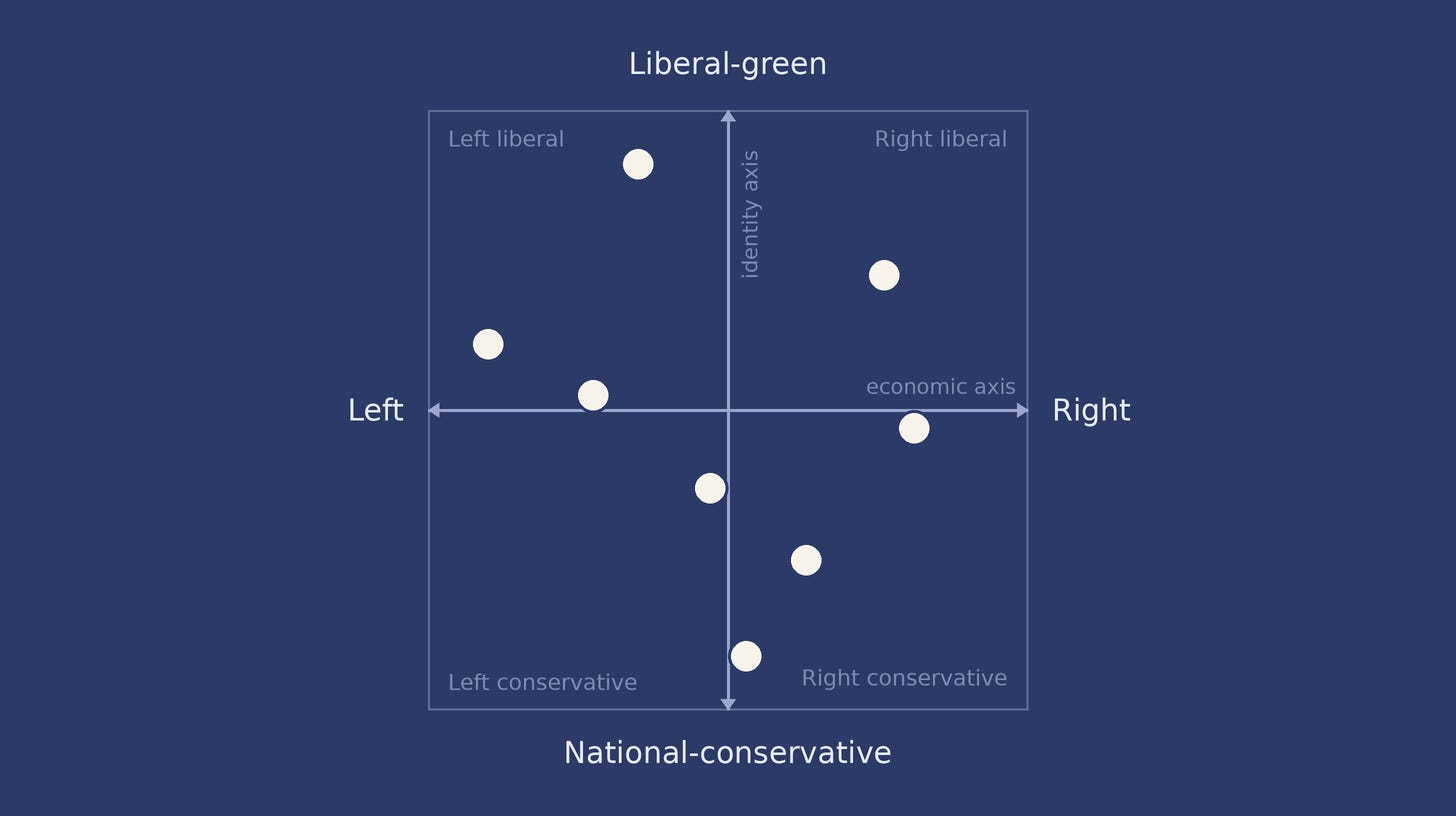
The economic axis runs left to right, from more collective to more individual — how risk, healthcare, retirement, labor protection and education are organized between the public budget, employers and individuals. This is the axis that center-left and center-right parties have organized around for more than a century. It is the standing axis.
The identity axis runs vertically, from liberal-green at one end to national-conservative at the other. It captures how open or restrictive a society is on immigration and citizenship, how growth-oriented or conservation-oriented it is on the environment, and more broadly how it defines the boundaries of national community. It is not reducible to the economic axis. Working-class voters can be on either side of it. Wealthy voters can be on either side of it. A center-left party can sit at the liberal-green end or closer to the national-conservative end; the same is true for a center-right party.
The four quadrants that result — left liberal, left conservative, right liberal, right conservative — give plural societies a roomy enough map to contain most of the real positions voters actually hold.
On top of the map sit causes — the specific issues parties champion within it. Climate. Immigration. Regional autonomy. Religion. Language. Gender. Causes are not additional axes. They are the salient issues of any given moment, and they cluster around particular regions of the map: climate concern clusters in the liberal-green half, immigration restriction in the national-conservative half. In the current world situation, environment and immigration are the two most salient causes — the ones around which new parties most often form. Other causes (regional autonomy in countries with strong regional identities, religion in countries where it remains politically salient, urban-rural divides where they are sharp) matter in specific national contexts.
The exact set of causes varies. The two-axis map does not. A plural society has more than just a left-to-right axis, and a political map that only shows one axis is incomplete.
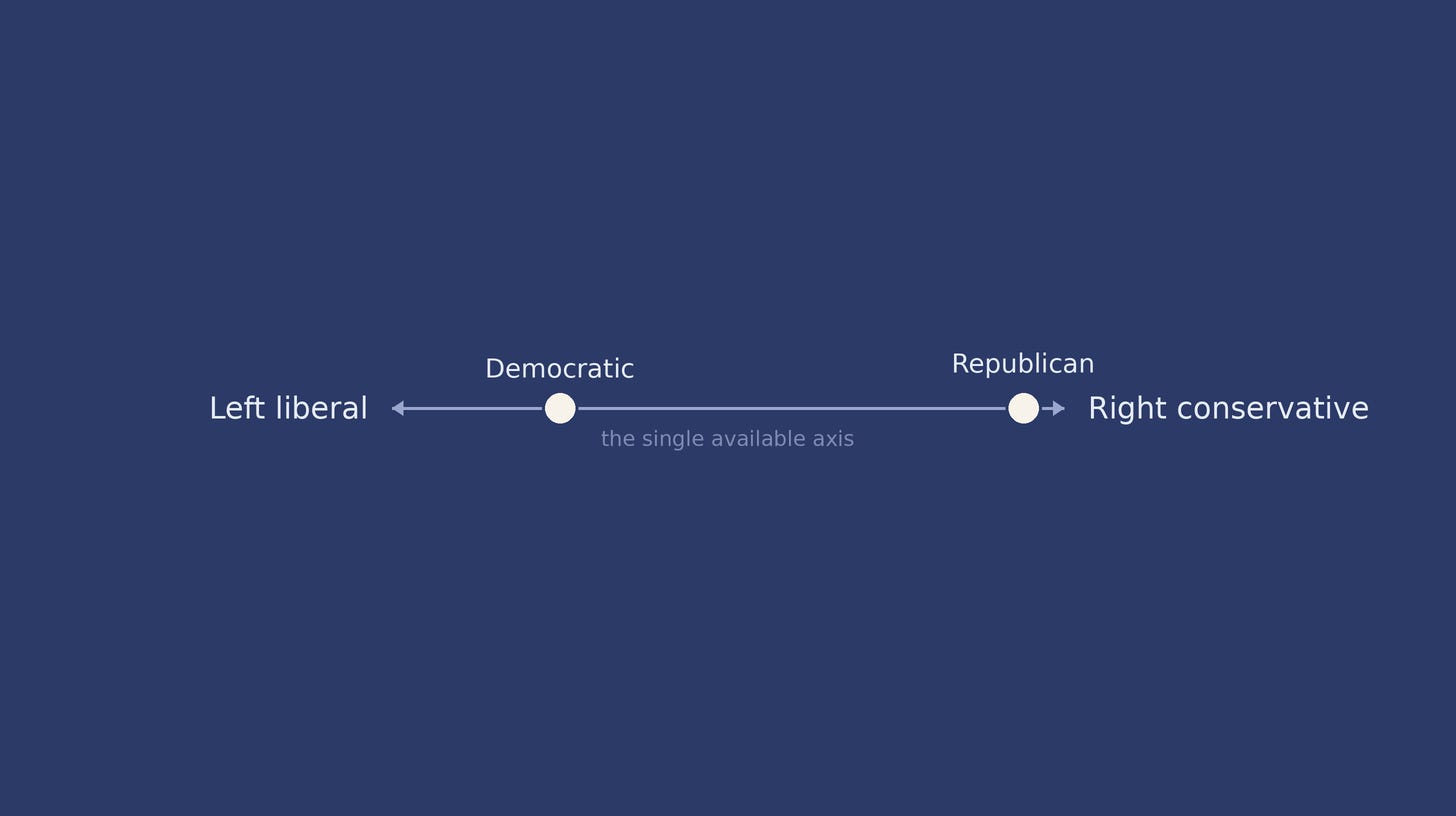
The United States is the clearest case of exactly that — a map collapsed to a single axis. Two parties divide one line running from left-liberal to right-conservative, and a voter's politics get read off where they land on it. The combinations that don't fit the line have nowhere of their own to go: economically left but culturally conservative, pro-market but environmentally green, the regionalist, the single-issue voter. Each gets absorbed into one of the two parties or drops out of the picture. The information the second axis carried is lost.
The standing center
Center-left and center-right parties carry the long-running economic axis.
This is what they are organized around. They have programmatic platforms across many domains — economy, healthcare, education, foreign policy, justice — because the economic axis touches all of those. They build administrative depth. They cultivate civil-service relationships. They negotiate with each other across cycles. They have governing experience and continuity habits that come from being expected to govern in some combination most of the time.
In proportional systems, these parties are usually the largest. In many European democracies, the center-left and the center-right together account for somewhere between 40 and 60 percent of the vote. Each alone clears 20 to 30 percent in a good cycle and 12 to 20 percent in a weak one. Their popularity changes — the center-left was dominant in mid-twentieth-century Europe; the center-right has been dominant in more recent decades; neither has been permanently dominant anywhere. But they are the parties around which most coalitions form.
The stability of the standing center is not the stability of any one center party. It is the stability of having two large, programmatic parties on the economic axis that can credibly anchor governing coalitions. When that stability erodes — when both center parties collapse to single-digit shares, as has happened in a few European countries during particularly turbulent decades — coalition-building becomes much harder and the political system enters real crisis. The standing center is the load-bearing structure of multiparty politics.
Parties organized around a cause
The two axes of the map are stable. The causes that animate any given cycle are not.
Green parties organize around climate and the environment. Far-right parties usually organize around immigration and national community. Regional parties organize around autonomy where it exists. Single-issue parties of various kinds come and go. Each of these parties carries a cause inside the map; none of them carries the whole map.
These parties are not lesser, and they are not unserious. Some have built real governing track records. Some have become the largest party in their country. But they tend to behave differently from parties that carry the standing economic axis, and the difference is worth naming carefully.
A cause is something that responds strongly to changing conditions in the world. Environmental concern rises after major climate events, IPCC reports, droughts and floods. It falls when economic worries dominate the news cycle. Immigration salience rises when border crossings increase, when high-profile incidents occur, or when refugee flows accelerate. It falls when the news cycle moves elsewhere. These are not stable issue intensities the way the economic axis is. They move.
A party whose support is tied to the salience of a single cause inherits that volatility. Green parties have surged in election cycles following environmental crises and shrunk in cycles dominated by other concerns. Far-right parties have surged during refugee waves or economic anxiety and contracted when those conditions eased. The party’s structural position on the map does not change. The salience of the cause it carries does.
This is not a criticism. These parties play a real role: they make sure their cause stays represented in parliament even when the major parties would rather not center it. Without a green party in the room, environmental concerns can be sidelined. Without a far-right party in the room, immigration concerns can be ignored or treated only by proxy. The political map is more honest when each major cause has a container — and in the current world situation, the most important containers relate to the environment and immigration.
What it does mean is that the popularity of these parties is genuinely not guaranteed. They rise and fall with conditions in a way that center parties do not. A multiparty system that depends on a green party being at 15 percent forever, or a far-right party at 20 percent forever, has not understood what those numbers represent. They represent the current salience of a cause. The next cycle’s salience may be different.
The 25 percent ceiling and the coalition arithmetic
In proportional systems with a roomy political map, the largest party usually receives a maximum of around 25 percent of the vote. Sometimes a bit more in a strong cycle, sometimes a bit less in a weak one. Rarely much more.
This is not because voters are indecisive. It is because there is enough choice on the ballot that no single party absorbs everything on its side of the map. A voter who agrees with the center-left on the economic axis but cares more about the environment has a green party available. A voter who leans center-right but is restrictive on immigration has a different option than the standard center-right party. The map’s diversity expresses itself as vote distribution.
A ceiling around 25 percent means no party governs alone. Coalition-building is structural rather than optional. A government has to assemble a working majority — at least 50 percent of seats in the lower chamber — from two, three or sometimes four parties.
The arithmetic is what it is. If the largest party has 25 percent, it needs partners contributing another 25 percent. That can be one bigger partner, two medium ones, or several smaller ones. Different combinations are possible from the same parliament. Different combinations have been formed in many countries from successive parliaments where the parties hardly changed.
This is the central mechanism of coalition politics. The map produces diverse representation; the diverse representation forces negotiation; the negotiation produces coalitions; the coalitions govern. Each step is structural.
Why this doesn’t produce pendulum politics
The popularity of any single party in a multiparty system is not guaranteed. Parties rise and fall. Greens surge in one cycle and shrink in the next. Far-right parties become the second-largest party in some elections and the fourth-largest in others. Center parties have decades of dominance and decades of difficulty.
In a two-party system, this kind of shift produces pendulum politics. The party that lost the last election eventually wins; what was built gets dismantled; what was dismantled gets rebuilt under a different name. Major policy lurches with each cycle. Nothing long-term gets built.
In a multiparty system, the same shifts produce something very different.
The reason is structural. Even when one party rises dramatically and another collapses, the new coalition still has to be assembled from the available parties. The new largest party still needs partners. Those partners are usually parties that were also in the previous government, or that have governed before, or that will need to govern with the new party in some combination in the future. Burning bridges is irrational, because the bridges are needed.
The composition of the coalition changes; the underlying commitments largely do not. A green surge brings climate policy further forward but does not unravel healthcare. A far-right surge brings immigration restrictions but does not dismantle the pension system. The new partners negotiate with the standing center, which carries most of the wellbeing-relevant infrastructure on its programmatic platforms. The infrastructure persists because the center persists, and the center persists because the economic axis it organizes around does not collapse the way single-issue salience does. Coalition negotiation also pulls partners toward each other, which in practice means toward the center — the location where compromise becomes possible.
This is why coalitions absorb shocks that two-party systems amplify. A two-party system has no buffer. When one of the two parties shifts hard in a particular direction — when populist energy captures it, or a fringe faction takes control — the entire camp moves with it. The coalition system has buffers. A new party at the table changes the negotiation; it does not change the structure underneath the negotiation.
Even complete opposites in parliament do not produce reversal. A green party and a far-right party can sit in the same parliament without either becoming a governing partner of the other. The parties closer to the center form the majority of the coalition; the parties at the edges shape the debate but do not dictate the outcome. The standing center plus one or two partners is the workable shape. The extremes are visible, audible, real — and not, in most coalition systems, in a dominant governing position.
Time horizons
There is a related effect, and it is the most direct connection between the political map and the wellbeing project: the two systems operate on different time horizons.
A two-party system rewards short-term thinking. The party in power knows it might lose total control in two or four years. The opposing party, when it returns, has reason to dismantle what was built. The cycle’s defining time horizon is the next election. Programs are designed to deliver visible results before voters next vote on them. Long-term investments are hard to defend, because the party that pays the political cost of building is not the party that collects the benefit when the project matures. The incentive structure points at quick wins, symbolic moves and short-term raids on the budget before power is lost.
A multiparty coalition system rewards long-term thinking. Every party in the room knows it will probably need to be in some future coalition with most of the other parties at the table. The composition of the next government will be assembled from this same parliament, or one not very different from it. A short-term raid on a future partner’s priorities is irrational, because the same partner will be needed in the next negotiation. A program designed to collapse with the next government’s arrival is irrational, because the next government is likely to include the current party in some configuration. Long-term decisions become structurally easier to make.
Coalitions produce compromise, and compromise produces decisions designed to outlast the cycle that made them. The parties know they have a good chance of being in the next coalition too. Burning the program built last cycle would be burning their own future credibility. Building a program designed to last is what protects that credibility.
This is the structural reason multiparty systems are a better fit for the wellbeing project than two-party systems. A wellbeing system is built across many cycles. It needs decision-makers with horizons that span those cycles. Two-party systems compress the horizon to the next election; multiparty coalitions extend it across many.
The map produces diversity. Coalitions produce compromise. Compromise produces long horizons. Long horizons produce the kind of design that wellbeing infrastructure requires.
What this implies
The diversity of the population needs the diversity of the political map.
When voters can see their actual priorities represented — not approximated, not flattened onto someone else’s preferred axis, but represented — they engage differently. They feel less excluded. They escalate less. They are more willing to accept that their preferred policy did not win this cycle, because their party was in the room and the negotiation was real.
When voters cannot see their priorities represented — when they are forced to choose between two parties that don’t quite contain what they care about — something else happens. Some go to one of the two parties anyway and become the wing of it that tries to pull it toward their concerns. Some withdraw from politics. Some support whatever movement claims to represent the missing cause, whatever its other features. The compression has political costs.
A roomy political map is therefore not a luxury. It is what allows plural societies to contain themselves through their politics rather than around it.
The popularity of any one party will continue to change. World conditions move. Generational concerns shift. New causes emerge as old ones recede. What stays stable is the structural fact that the map has multiple axes, that each major cause has at least one party representing it, and that no single party can govern alone. That is the foundation on which long-term commitments survive across cycles.
Which is to say: the political map and the coalition arithmetic that follows from it produce, when they work together, the conditions for the kind of layered, multi-cycle design the wellbeing project requires. What produces that map in the first place — the electoral rules that translate votes into seats — is the next question.
Closing
A political map roomy enough to contain a plural society is the structural representation of that society’s actual diversity.
The standing economic axis carries the center; other axes have their own containers; sentiment-driven parties keep their axes represented even when the major parties would rather not center them. The 25 percent ceiling on the largest party is what forces coalition-building from this diverse representation. Coalitions are usually built from two to four parties, in combinations that change across cycles.
The popularity of any individual party is not guaranteed, and it changes. World conditions move; salience moves with them; party support follows. But because coalition arithmetic forces continuous negotiation with most of the same parties from one cycle to the next, those shifts do not produce pendulum politics. The composition of government changes. The underlying commitments largely do not. The standing center holds; the extremes are present but not governing; continuity sits in the system rather than in any single party.
The dials in play
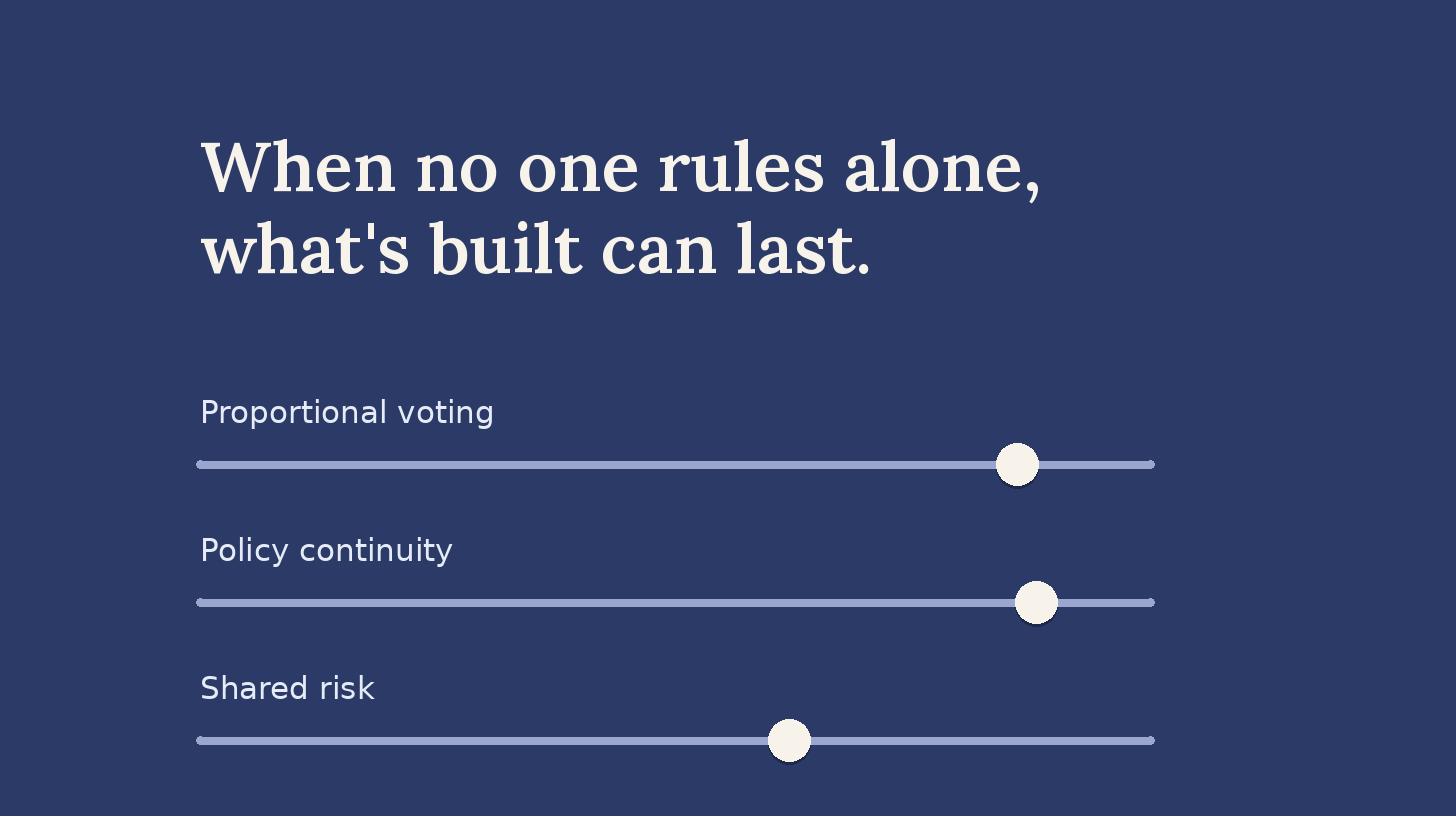
Electoral design (winner-take-all ⟷ proportional). Proportional rules draw the roomy map and hold the largest party near a 25% ceiling, so no one governs alone — diversity becomes coalitions instead of a two-camp fight.
Policy continuity (single-term ⟷ across-terms). Because parties expect to share future coalitions, they build programs to outlast the cycle rather than to be undone by the next government.
Risk allocation (individual ⟷ firm ⟷ collective). The master dial downstream: durable, coalition-built politics is what lets shared-risk infrastructure survive shifts in party popularity.
What to ask your representatives
Instead of asking which single party you want running the country, ask: does the system let the priorities you hold get represented, or force them into one of two boxes that only approximate them?
Instead of asking who wins the next election, ask: when control changes hands, does what the last government built get refined — or torn up and rebuilt under a new name?
Instead of asking whether a party will deliver a program you want, ask: is the program built to outlast the government that passes it, and does the way votes convert into power make that durability possible?