


Mobility is usually discussed as a moral question, or as a country-level statistic.
The moral question is whether it is fair that some people rise and others do not. The statistic is whatever the OECD or the World Bank has measured most recently, usually about how often someone born in the bottom fifth of the income distribution ends up somewhere else by the time they are forty. Both framings are real, but neither reveals what mobility actually does, structurally, in the society it describes.
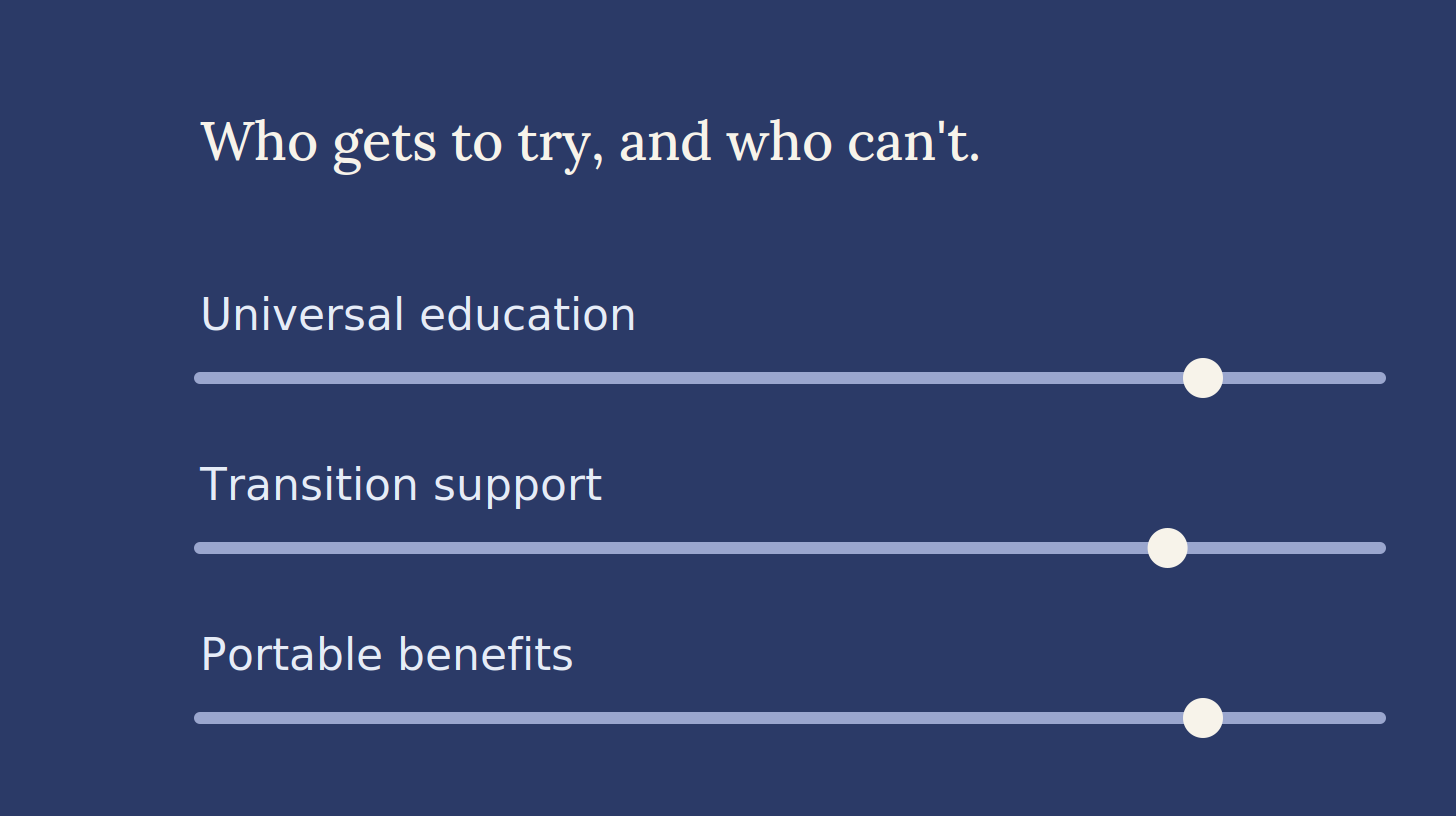
The central claim this arc develops is that mobility is one of the structural mechanisms by which a wellbeing society stays funded, stays broad and stays adaptive across generations. To see why, it helps to start with what a wellbeing society actually holds in place. A wellbeing society maintains what this project has been calling a floor — a set of protections, accessible across the population, that mean people are not destroyed by ordinary life events. Healthcare that does not disappear when a job ends. Income support during the gap between one role and the next. Education that is not gated by family wealth. Labor rules that make it possible to leave a job, retrain, and re-enter the workforce without being permanently set back. The floor is what catches people when life turns the wrong way, and what makes it reasonable for them to try things that might not work out.
The floor is expensive. It is paid for by the activity above it — by people working, building firms, hiring, inventing, taking risks that produce taxable income. And here the picture closes on itself. The activity that funds the floor is generated by people who can credibly attempt the moves that produce it, and the floor is one of the things that makes those attempts credible for people who would otherwise not be able to afford them. The two halves rely on each other. When the relationship between them is working, more people from more backgrounds reach the productive economy, the tax base widens, and the floor stays affordable. When the relationship breaks, the floor still exists on paper, but the activity above it narrows to whoever could already afford to take risk privately. This relationship — floor produces activity, activity funds floor — is what the next essay calls a loop, and it is the structural shape this arc is built around.
Mobility is the mechanism that keeps the relationship working. It is what determines whether the productive economy draws from a wide base or a narrow one.
The arc reads mobility from that angle. What the wellbeing society needs from mobility, and what mobility needs from the wellbeing society. What produces it, and what blocks it. What gets lost when trajectories stay closed. Five questions, in roughly that order.
The first asks what mobility actually does for a wellbeing society. The next essay names the relationship described above as a loop — floor produces activity, activity funds floor — and traces the two ways the loop can fail. A floor without mobility, where stability slowly thins because the activity above it narrows. Mobility without a floor, where dynamism concentrates among those who can afford to fail and most of the population learns to stop trying. Both are recognizable as configurations of real countries. Neither is stable.
The second asks why the system needs mobility, and what specifically builds it. Strong floors are expensive, and the standard objection is that they cannot be financed. The arc’s answer is that mobility is the financing mechanism — a wider tax base, a broader pool of people who try, the matching of talent to roles, demographic durability under inverting age pyramids. Saying mobility produces these things is not the same as saying how a society builds it in the first place. The arc takes both questions in turn. One essay names what the system gets from mobility when it works. The next names the design dials that produce it — universal early education, education access through to university, healthcare that follows the person across jobs, retraining and re-entry infrastructure later in life, labor law that does not tie security to a single employer, a safety net that buffers transitions — and names what blocks them.
The third asks what happens when trajectories stay closed. When mobility is blocked, people do not always express it as anger. More often they withdraw — from the labor market, from political life, from civic participation, from the institutions they no longer expect to deliver. From outside, this reads as apathy or lack of motivation. From inside, it is the rational response to a system that has stopped signaling that effort compounds.
The fourth asks what absence at the top reveals. Patterns of who reaches positions of influence are usually discussed as questions of representation or identity. They are also questions of mobility. When entire groups consistently do not appear at the higher levels of a society’s institutions, the absence is rarely about ability. It is about which trajectories were structurally available and which were not. Representation, read this way, is a diagnostic signal of what is failing underneath.
The fifth asks how unequal continuity compounds across generations. The most legible version of the question is the long American case — a starting point set in slavery, preserved through segregation, never corrected through deliberate reset, and now operating under formally neutral rules that protect continuity for those who already have it while leaving those without it to enter compounding systems from a near-zero baseline. The mechanism generalizes. Continuity-preserving systems applied to unequal starting points stratify rather than converge. But the worked case is the one to read closely.
A note on what the arc does, and what it does not. It reads mobility structurally, not as a moral verdict on any particular society. Country examples appear where they sharpen the structural argument — the United States as the recurring case of dynamism built on individual exposure, France as protection that quietly sorts, Finland as the configuration that has come closest to turning the dials in the building-block direction. The argument is structural. Other countries with similar features are subject to the same analysis. The countries are the data, not the targets.
The next essay turns to the loop.
Next: Mobility as both engine and outcome — the loop the whole system runs on.