


The standard objection to the wellbeing society is that it costs too much. Universal healthcare, real unemployment insurance, long parental leave — the floor is expensive, and the usual worry is that a society can be humane or productive, but not both. This essay argues the objection has it backwards: the floor is part of what produces a broad productive class in the first place. What links the two is a single mechanism.
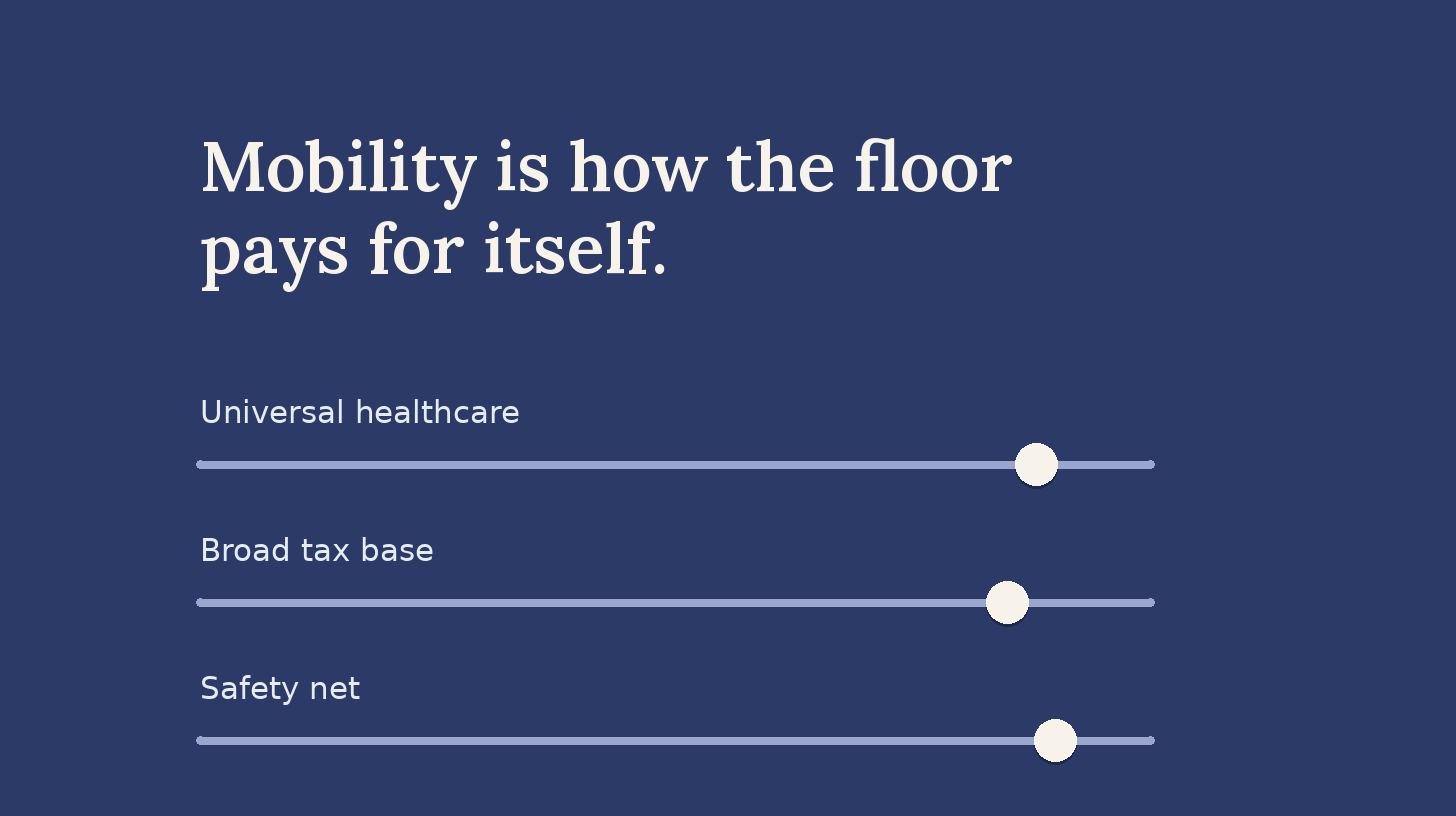
The floor the wellbeing society holds is not a subsidy from the people who work to the people who do not. It is part of the infrastructure that produces the people who work and build, across a wider base than would otherwise be possible.
The transmission layer between the floor and the activity above it is mobility.
Without mobility, the floor still exists, but the people on top of it are mostly the people who would have been there anyway. The base of the economy narrows to whoever could absorb risk privately. The system runs down. With mobility, the floor produces something specific in return: more of the population can credibly attempt the moves that produce economic value, and more of the value they produce flows back into the system that made the attempts possible.
This essay names what the wellbeing society actually gets from mobility working — not as a moral question, not as a downstream property, but as one of the system’s primary structural inputs.
A wider tax base
The most direct thing mobility produces is a broader tax base.
The wellbeing society is funded by the people inside it who reach productive roles and stay in them. A society where many people from many backgrounds reach those roles has more taxpayers than a society where only a narrow segment does. This is mechanical, not moral. The wellbeing society’s revenue is roughly proportional to the breadth of the productive population multiplied by the productivity of that population. Mobility moves the first variable.
When healthcare is not tied to a particular job, when education is not gated by family wealth, when failure is not catastrophic, more of the population can sustain working lives that produce taxable income. People who would otherwise have dropped out of the labor market after illness, family crisis, or a single bad year stay in it. People who would otherwise have remained in stable but low-output roles take the risks that lead to higher-output ones. Both effects show up in the tax base.
What a wellbeing society produces names the wider-returns mechanisms in detail: participation expansion (women, immigrants, parents of young children, people with chronic conditions), higher per-worker tax contribution through human capital, lower contingent liabilities through prevention. Those mechanisms all depend on mobility working.
A wellbeing society without mobility holds a floor that catches people from a narrow part of the population and lifts them back into a narrow set of trajectories.
A wellbeing society with mobility holds a floor that produces a wider working population than would otherwise exist.
The tax base is not the only thing this expansion produces. But it is the most visible thing on the public budget, and it is the one that closes the standard objection most directly.
A broader pool of people who try
The economy needs people who try. Founders. Builders. Engineers. Doctors. Professors. Inventors. People who change fields mid-career. People who leave stable jobs for unstable ones because they think they can do something better than what already exists.
The pool of people who can credibly attempt these moves is not naturally broad. Most attempts fail. Failure usually costs the person attempting it more than success rewards them. In a society where the cost of failure is catastrophic — lost healthcare, lost housing, lasting damage to a credit record, no clear way back into the labor market — the people who can absorb that cost are the people who were already insulated. The pool contracts to those who can afford to fail.
This is one of the loop arguments developed in Mobility as both engine and outcome. The contraction is severe: when the cost of failure is high enough, even people with strong reason to try will not. The talent pool that drives the productive economy is not the complete talent pool the society contains; it is the talent pool the society lets take risk. Every productive society needs people who take risks.
Mobility widens that pool. When falling does not mean losing the things that make recovery possible, more people from more backgrounds try the moves the economy needs. Some of those attempts succeed. The successes feed back into the activity above the floor — into firms started, into industries created, into productivity gains that take years or decades to materialize. The failures, in a system where failure is survivable, do not remove people from the economy permanently. They become learning that the next attempt builds on.
The broader the pool of people who can credibly try, the more of the economy’s potential output gets realized. This is not a generosity argument. It is a productivity argument.
Income differences that reward effort
A common misreading of the wellbeing society is that it is anti-success. The floor flattens outcomes; the safety net dulls incentives; the design is suspicious of wealth.
The opposite is true.
The wellbeing society depends on income differences. The activity that funds the floor is generated by people who earn meaningfully more than what the floor alone provides. The risks people take are taken because the upside is real. The investments people make in skills, in long training, in years of unprofitable work that may eventually pay off, are made because successful effort is rewarded with outcomes the unsuccessful do not get.
A wellbeing society without income differences would not be a wellbeing society. It would be a stagnation society. The floor would still exist, but nothing would happen above it.
The point of the floor is not to flatten outcomes. It is to make the cost of trying bearable for more of the population, so that the income differences that result reflect effort and judgment more than they reflect who could afford to attempt in the first place.
This distinction matters because it changes what the wellbeing-society position actually argues for. It does not argue that wealth is a problem. It argues that what wealth is allowed to buy is a question worth asking. When wealth translates into comfort, choice and security, that is what success is for. When it translates into structurally advantaged trajectories — preferential access to education, insulation from failure that no one else gets, exemption from the rules the rest of the population operates under — it begins to suppress the mobility the system depends on.
The wellbeing-society design is pro-trajectory, not anti-success. Income differences are part of the engine.
Talent reaching the role it fits
An economy is productive when talent is matched to roles. The match is rarely automatic. People often spend years in roles that fit them poorly because moving carries costs they cannot absorb — healthcare that disappears with the job, retirement contributions that pause or restart at zero, a credit record that cannot survive a few months of lower income.
When those costs are high, people stay where they are. Some of them are in roles that use their capacities well. Many are not. The matching process happens for those who can afford it and slows for everyone else.
The velocity argument makes the productivity case for this directly. Buffering allows movement. Movement allows matching. Matching produces output. A society where workers can change jobs, change industries, retrain at thirty-five or fifty, or leave a stable role for an unstable one without losing the things that make recovery possible is a society where talent gets to the right place more often. The matching effect compounds across the economy.
Mobility is what makes this dynamic broad. Without it, the matching that happens is the matching that happens at the top of the income distribution, where people can afford to move on their own resources. With it, the same dynamic operates across a much wider segment of the population. Talent that would otherwise have been stuck in a role that did not use it well finds the role that does.
This is not a small effect. The standard economic measure of productivity is output per worker. The composition of who works in which role is one of the largest determinants of that number. Mobility moves the composition.
Demographic durability
Age pyramids are inverting across the developed world. In nearly every wellbeing-society candidate, fewer people of working age will be supporting more people who are retired, ill, or otherwise dependent on the system. The arithmetic of the floor depends on getting more productive activity out of each working-age person and on keeping them productive for longer.
Mobility is what makes this possible from a broader base.
A society where mobility works late in life — where people can retrain at forty-five or fifty-five into the roles that the economy actually needs by then — has a longer effective working population. A society where mobility stalls in early adulthood, where credentials lock trajectories before people are thirty and re-entry after a setback is unrealistic, has a shorter one. The number of working years per person is partly biological and partly designed. Mobility moves the designed part.
This effect is going to matter more in the next two decades than it did in the last two. The wellbeing societies that hold up under demographic pressure will be the ones that can keep more of the working-age population in productive roles, across more of life, from a wider range of starting points. Mobility is not a side concern in that calculation. It is part of how the calculation comes out.
What this adds up to
Each mechanism on its own is structural. Together, they form the answer to the standard objection.
The wellbeing society is not a transfer from the productive part of the economy to the unproductive part. It is part of what produces the productive part. The floor widens the tax base, broadens the pool of people who can try, supports the income differences that reward effort, allows talent to reach the role it fits, and keeps more of the working-age population productive for longer.
Strip out any one of these, and the economic case weakens. Strip out all of them, and the wellbeing society does not pay for itself. Keep them, and the system funds itself by producing more of the activity that funds it.
The productive class is not subsidizing the floor.
The floor is one of the reasons there is a productive class as broad as it is.
Closing
The standard objection to the wellbeing society asks how it will be paid for. The answer is that mobility is how. Not as a moral nice-to-have, not as a downstream property of getting the rest of the design right, but as the mechanism that links the floor to the activity above it.
A wellbeing society that suppresses mobility — through expensive education, through employment-tied protection, through credentials that lock trajectories early, through any of the design choices that raise the cost of trying for most of the population — undermines its own financing. A wellbeing society that holds mobility broad makes the financing question much smaller than it otherwise would be.
The essays ask what produces this — what specific design choices build mobility, and what specific design choices block it.
The dials in play
Healthcare (employer-tied ⟷ universal). When coverage follows the person, illness and job changes stop ending careers — so more people stay in productive, taxable work.
Financing of the floor (narrow & fragile ⟷ broad & durable). A broad, durable base is both what mobility produces and what the floor needs: more people reaching productive roles means more taxpayers funding it.
Safety-net depth (thin ⟷ deep). A deep net makes the cost of trying survivable, so a wider pool of people attempts the moves the economy needs.
What to ask your representatives
Instead of asking whether the floor is too expensive, ask: how many more people could reach productive, taxable work if failure here weren’t catastrophic?
Instead of asking how to cut benefits, ask: which of our design choices raise the cost of trying — and for whom?
Instead of treating healthcare and education as pure costs, ask: are they tied to a job and to family wealth, or do they follow the person and widen who gets to participate?