


Two people can take the same hit and land in completely different places — and the reason usually has little to do with them. It has to do with how the place they live is set up to respond, and that setup is not permanent. Someone chose it; someone can choose again.
When a society decides who its failures are, it almost never names a person. It names a group — the people who won’t work, the ones who made bad choices, the newcomers who take more than they give — because a group is abstract enough to run a campaign against. The blame is general; the target is a crowd.
But pull one person out of that crowd. Someone who lost the job, then the health coverage that was tied to it, then the rent — and stayed down. Move that person, unchanged, to a different country. Same talent, same effort, same bad luck. In one country they spiral. In another they stumble and recover. The person didn’t change. The settings around them did.
This project starts from an uncomfortable idea: most of what we call personal failure is not personal. It is designed. A society is a system, and that system runs on a handful of dials — how it writes its labor laws, how deep its safety net runs, whether healthcare and a pension follow the person or the job, how much your starting point decides your finishing line. Those dials are set by people, in rooms, on purpose. They could be set differently tomorrow.
Because here is what most societies are: not built to catch you. They are built to keep moving, and to let whoever slips off carry the cost of slipping. Lose your job and you can lose your health coverage, your retirement, and your footing in the same month — because all of them were bolted to that one job. A setback turns into a sequence of negative events. Falling becomes final. We’ve been taught to call this freedom. Or bad luck. Or someone’s own fault.
A wellbeing society is not a richer society, or a softer one, or one that promises everyone the same result. It is one thing: a society where a setback is survivable. Where falling is not final. Where the floor sits high enough that a person can take a risk — change jobs, retrain, start something, leave a bad situation — without wagering their whole life on it going right. It spreads risk across many societal pillars instead of stacking it all on your shoulders. Not so that no one ever falls. So that falling doesn’t end them. And a society where more people can afford to try is not only kinder — it is more productive: more people inventing, founding companies, building, trusting each other enough to leap.
None of this is natural law. The reason a layoff is a catastrophe in one country and an inconvenience in another is not national character or climate or culture. It is the dials — and dials are set by policy, defended by some, and changeable by all. What was designed can be redesigned.
Which is why the questions we’re handed at election time are mostly the wrong size.
We’re asked which side we’re on; we should ask who carries the risk. We’re asked whether to cut taxes or raise them; we should ask whether protection follows the person or vanishes with the paycheck. We’re asked what a party will do this term; we should ask what it will build that outlasts the term. Politicians get away with the small questions because most of us don’t know how to ask the big ones.
That is what this blog is for. It will never tell you who to vote for. It will show you how the system is built, dial by dial, so that the next time someone calls a choice a fact of life, you can see the choice underneath — and ask for more, knowing what “more” would even look like and how it can be financed.
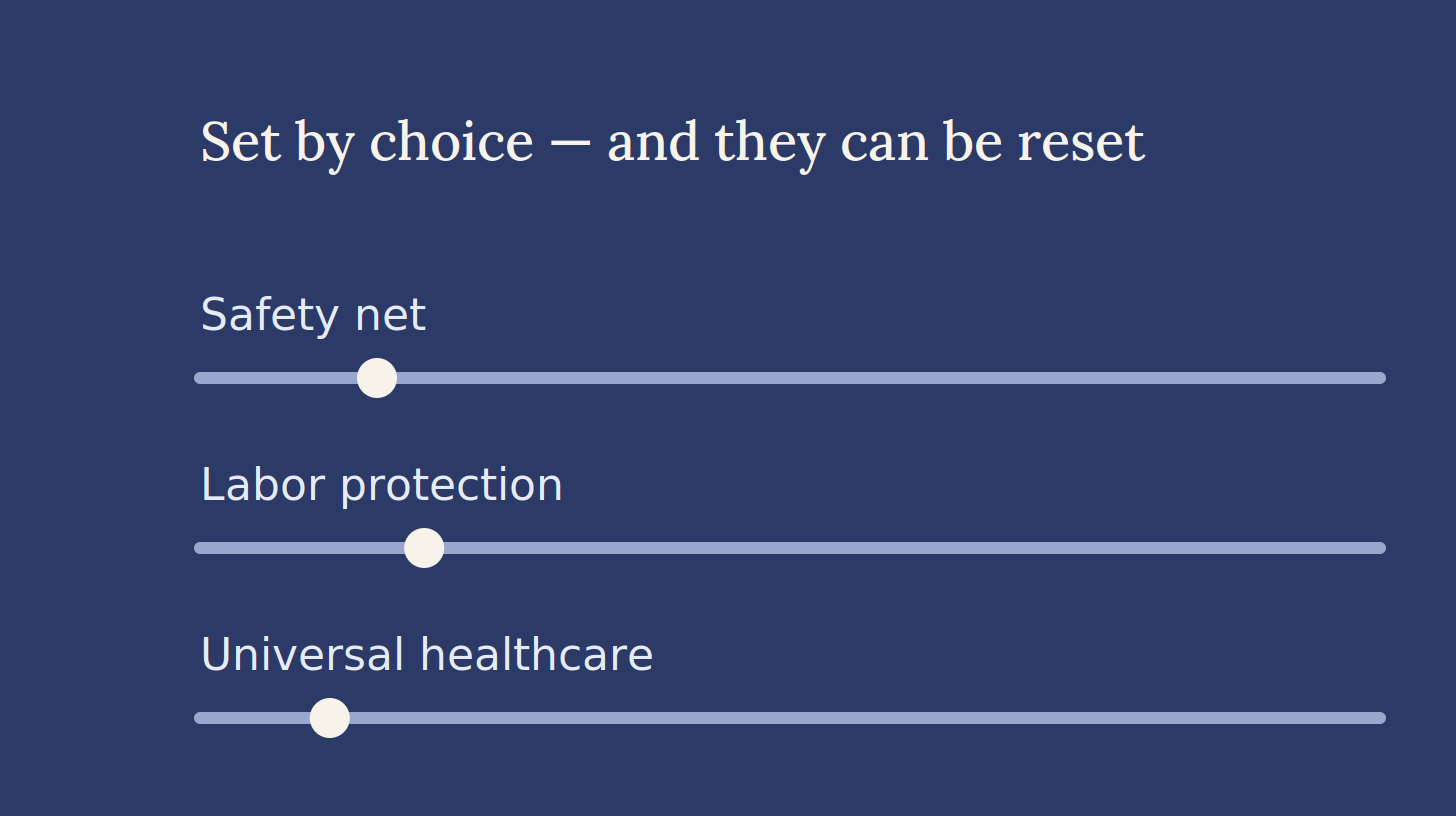
None of this is fixed. The labor laws, the safety net, how far a person can travel from where they were born — these are dials, set by choice, and they can be reset. That is not a hopeful slogan; it is the plain meaning of design: something decided, that can be decided again. What follows is a guided tour of the dials — what they are, how they’re set where you live, and what it would take to move them. Start anywhere. But start.
If you'd like a path: The wellbeing society → — the calmer, fuller picture of what a wellbeing society actually is, and what the rest of these essays build toward.