


Say the words “wellbeing society” and most people picture a place — somewhere cold and prosperous, nice if you can get it. That mistakes an outcome for a definition. It’s not a place or a temperament; it’s a set of choices about who absorbs the hit when life goes wrong
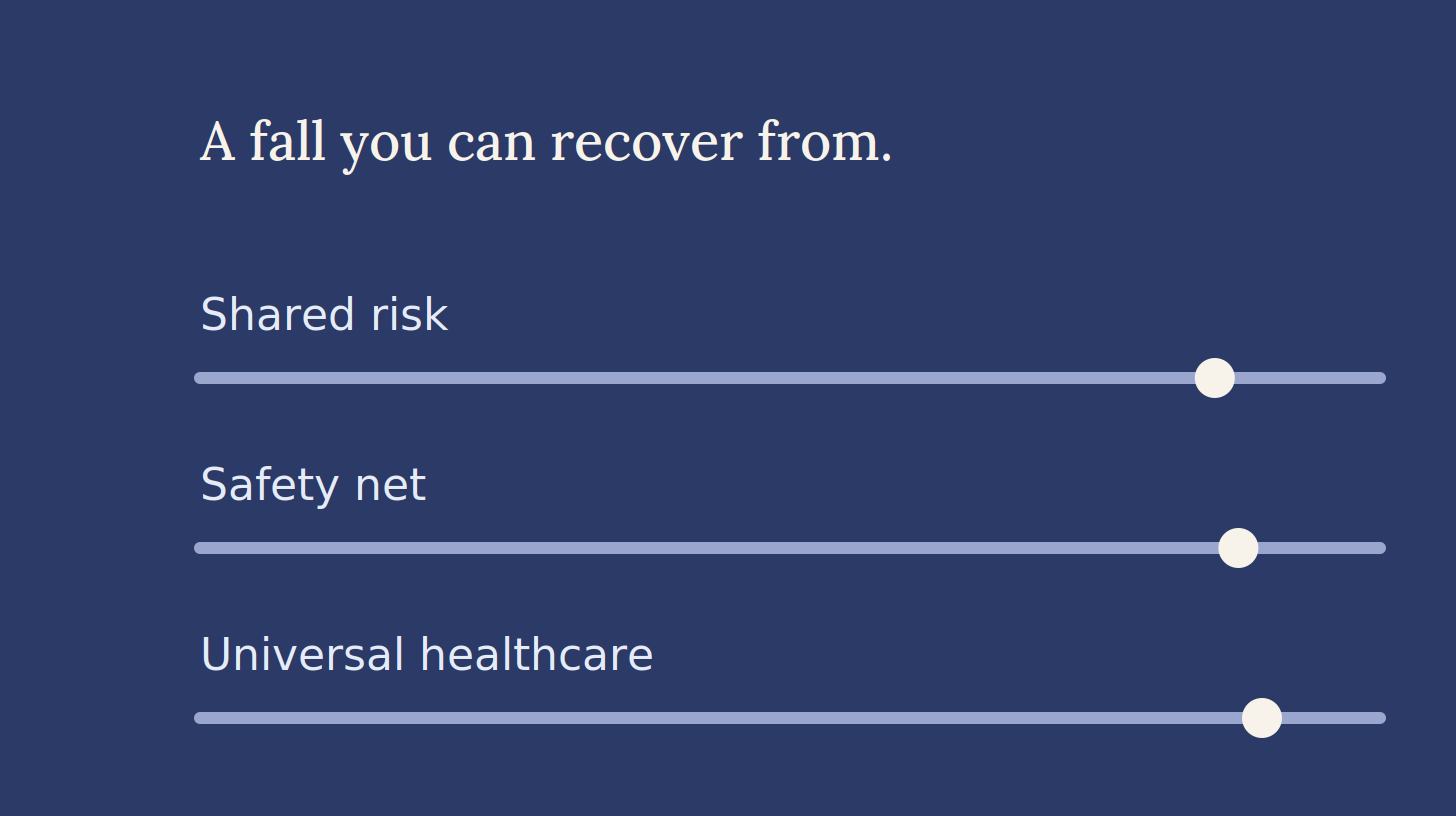
A wellbeing society is not a place or a temperament. It is a set of choices about who absorbs the hit when life goes wrong: you alone, your employer, or the country as a whole. Those choices can be made anywhere. Some countries have made them on purpose. Others have made the opposite ones, just as deliberately, and live with the opposite results. So the real question about any country, including your own, isn’t whether it is that kind of place. It is which of these choices it has already made, usually without telling anyone, and what they cost the people living there.
Here is the whole idea in a line: a wellbeing society is one where falling is survivable and getting back up is possible.
It does not promise that everyone ends up happy, or equal, or spared from hardship. It promises only that the cost of a bad turn is bounded. Lose a job, get sick, leave a marriage, start a business that fails, get born to the wrong parents — none of it has to harden into a life sentence.
That bound is what unlocks everything above it.
When people believe a fall won’t end them, they do braver things. They start the business. They leave the job that was going nowhere. They go back to school at forty. They have the child before the spreadsheet promises they can insure against every disaster. They show up fully, because taking part no longer puts everything they have at risk.
When people believe a fall is final, they do the reverse. They stay put, hedge, keep the safe job and the safe opinion and the safe life. Not for lack of nerve, but because the cost of being wrong is real and they have counted it in their spreadsheets: the house, the health coverage, the kids’ stability, all riding on not slipping. A society full of people playing not to lose is not free in any way that counts, however many freedoms are written into its laws. It has only made courage expensive, and sometimes survival itself.
So the first thing a wellbeing society does is make recovery believable enough that people stop bracing for the worst and start building toward something better.
It helps to be clear about what this is not, because the word wellbeing invites soft readings. It is not the same as rich. A country can be enormously wealthy and still let one illness empty a family’s savings, still tie your health coverage to your job, still leave whole groups so far behind at the start that working hard barely changes where they end up. Wealth is not the variable; who pays when things go wrong is. Nor is it the same as generous. A protection that reaches only the people who already have it is not a safety net — it is a wall, with everyone outside it absorbing the risk the insiders were spared. A wellbeing society is judged by what happens to someone on their worst day.
The oldest objection to all of this is that it is a luxury — something a country does after the economy is humming, and at its expense. The argument runs like this: safety nets breed dependency, protections gum up the works, and a country that chooses wellbeing pays for it in lost growth.
The countries that have actually built wellbeing societies are the answer to it. They sit near the top of the global tables for productivity and innovation, and several of them start more new businesses per person than the economies that pride themselves most on dynamism. That is not the signature of a trade-off. The confusion comes from mixing up two different dials. A flexible labor market and job security do pull against each other — a job that is nearly impossible to lose is also a job that is harder to get hired into. But wellbeing and performance do not, because wellbeing is not mainly about keeping your job. It is about what happens when you lose it. A country can run a fast, flexible labor market and still hold high wellbeing, as long as losing a job doesn’t also mean losing your healthcare, your home, and your savings in a single stroke. The craft is in pairing that flexible labor market with a strong safety net, so the economy stays quick and people still land softly. That balance is the work the rest of this blog takes on.
Once you see a wellbeing society as something a country builds rather than something it simply is, the conversation changes shape. It stops being about whether your country is generous enough, or culturally suited to it, or rich enough yet, and becomes a question about settings: who carries the risk when things go wrong, what kind of failure is made survivable, what a person can attempt without betting their whole life on it going right. Those are answerable questions, with different answers in different places — and no political tribe owns them. Governments of every stripe have set them, well and badly, on purpose and by neglect.
That is the move this whole project turns on. A wellbeing society is built, not inherited — which means it can be built anywhere, including where you live. It is a configuration: a handful of dials, each set somewhere between two ends, that together decide how hard life lands and how quickly a person gets back up. People set those dials, and people can move them.
From here, the work is the dials themselves: what they are, how they are set where you live, and what it would take to move them.
Next: Who turns the dials — the controls every society is already running on.