


In Who turns the dials, a country looked like a control panel: a handful of dials that someone, somewhere, had set. But before you can argue about where a dial sits, you have to see that it is a dial at all, and not just the way things are. That habit of seeing is what this essay is about.
Start with the habit it replaces. Ask why a country is in trouble and you’ll usually get an answer about its people. They’ve gotten lazy, or entitled, or angry, or tribal — or the fault is pinned on some enemy within, the group said to be behind everything that has gone wrong. The values slipped. The character of the place declined. The wrong people are in charge, or the right ones can’t get in. The story is always about who: which generation, which party, which group, which enemy.
That kind of answer is satisfying, because it points at a culprit. It is also close to useless. The people being blamed never behave the way the story says they should: they don’t feel ashamed, don’t stop, don’t turn into the citizens the diagnosis demands. Each side names the other’s character as the problem, both carry on exactly as before, and the machine that turns out both sides keeps running untouched.
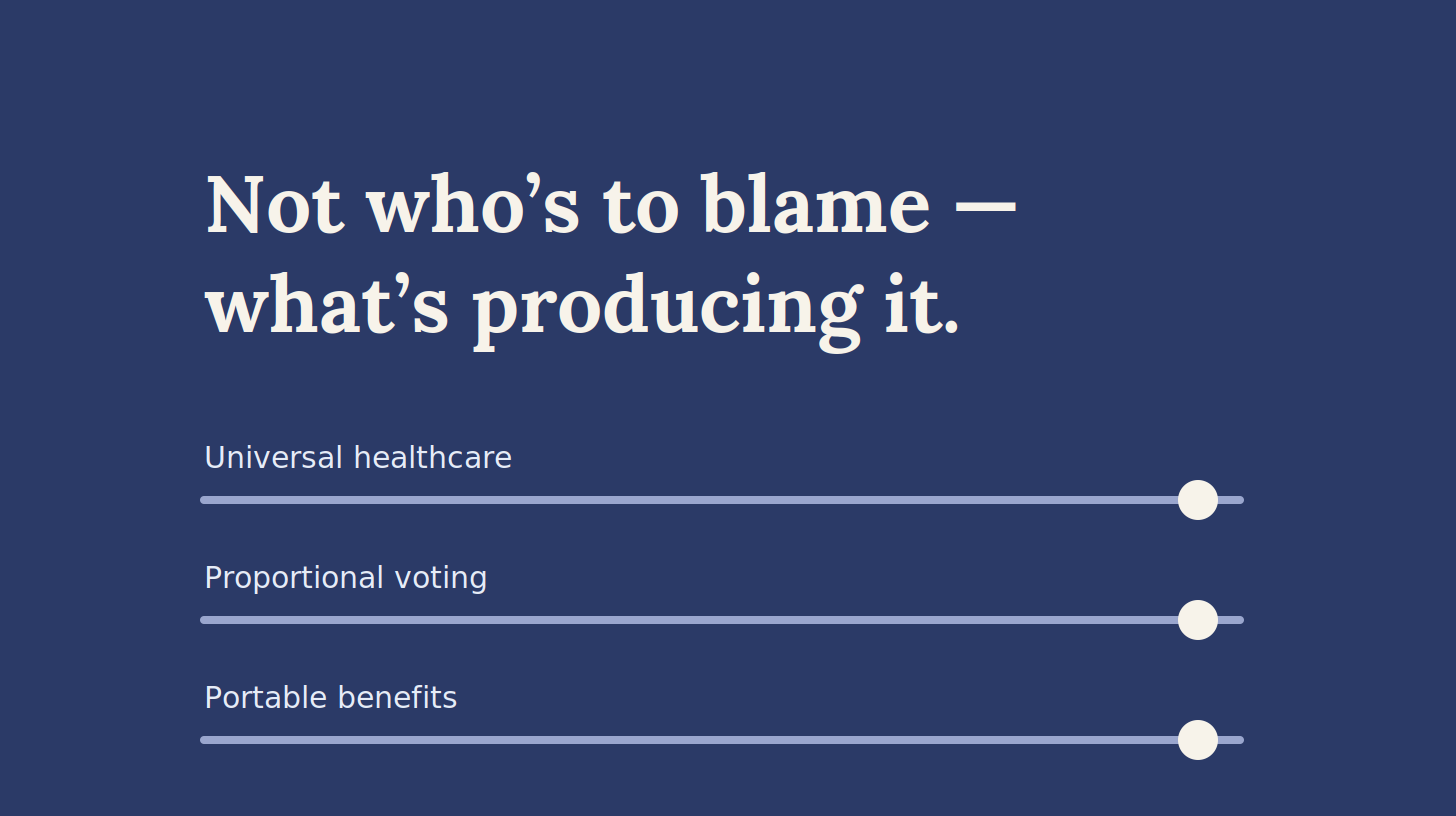
So treat the society as a system: a set of moving parts (rules, incentives, institutions, who carries the risk) that interact in predictable ways and produce predictable results. The dials are part of that machinery. Seen this way, how people behave is mostly a response to the machinery, not the root cause of the trouble. Tribal politics, stalled mobility, sinking trust, falling birth rates: each is what a particular setting of the parts tends to produce. Change the settings and the behavior changes too, often faster and further than whoever set them expected.
The shift from who is to blame to what is producing this is the move this whole project runs on. Worth learning on its own, before the later essays start using it everywhere.
Seeing it twice
Here is the exercise that makes the habit stick. Take something that bothers you about your country and explain it twice: first as a story about the people, then as a story about the setup. Then watch which version hands you something you could actually change, and which just hands you someone to blame.
Take polarization.
The people story is the one everyone already tells, and it is a good one: Americans have sorted into two camps that can’t stand each other, the social media feeds reward whoever is loudest and angriest, and decades of contempt have burned away the common ground. You can watch it happen at any holiday dinner table.
Now the setup. The United States elects almost every politician on every level with a winner-take-all method: one seat, one winner, every vote for anyone else thrown away. That single rule does an enormous amount of work. It allows only two parties to survive, because a third just splits one side and hands the win to the other. It forces each of the two survivors to bundle half a vast country into a single platform, so unrelated fights, from guns to abortion to taxes to the border, all stack onto the same line, your side against theirs. And it makes every election total: the losing half gets no share of power until the next round. Stack those up and the animosity follows on its own. Only one rival can ever beat you, and its win shuts your side out of power until the next election, so the other party stops being a set of people you disagree with and becomes the single thing standing between you and ruin. Under those rules, treating it as the enemy is not a character flaw. It is the sensible response. Ordinary people, dropped into that structure, end up behaving more or less the way Americans behave.
Change the rule and the behavior moves. Under proportional representation, a party that wins a fifth of the vote wins a fifth of the seats, so five or six parties become workable instead of two. A voter who likes neither big option now has somewhere to go. The disagreements that used to pile up inside two furious coalitions spread across several smaller ones. And because no single party usually wins outright, governing means assembling a coalition, which makes compromise the price of power rather than a betrayal of the tribe. Same citizens, same arguments, a structure that pays out for cooperation instead of combat. The heat comes down.
Both stories are true. Only the second hands you a lever. The first can only ask the other side to become better people, which has not once worked.
Try it again with how fast immigrants assimilate.
The people story: some groups are eager to fit in and some aren’t, some cultures sit easily with the host and some grate, some countries open their arms and some bolt the door. Also true, also something you can see.
The setup story: people drop their differences fastest when difference is expensive. In the United States, the safety net is thin and the labor market is unforgiving toward anything that reads as foreign, so an accent or a degree earned abroad becomes a real liability. Difference is expensive, and newcomers shed it hard and fast. Across much of Europe, a deeper safety net lowers the cost of standing out, and assimilation runs slower. Which is why the very same group can dissolve into one country and stay distinct in another, and why a single country can assimilate fast in one generation and slow in the next. The people story asks who is trying hard enough. The setup story asks how expensive the country has made it to be different.
That is the whole trick. The lens swaps who is to blame for what is producing this, and what it turns up is usually something nobody actually chose. No one sat in a room and decided America should be this polarized; the voting rule grinds it out on its own.
Four guardrails
This habit gets misread in a few predictable ways, so four quick guards.
First, none of this says people don’t matter. People act, and their choices move real things. The claim is only that the pattern across millions of people is set more by the machinery than by anyone’s character. Put decent people in a badly built system and you can still get ugly results; put flawed people in a well-built one and you can still get decent ones. The shape of the room matters more than the virtue of the crowd inside it.
Second, not everything is a system problem. Plenty of trouble really is personal, or cultural, or moral. The lens is one tool among several. A rough test for when to reach for it: if changing a rule would change the outcome, you are looking at structure; if it wouldn’t, the cause lies somewhere else.
Third, naming the system is not the same as excusing the people in it. Picture a firm that keeps promoting bullies because bullying hits the quarterly numbers. Pointing at that incentive lets no individual bully off the hook, but it does explain why firing one and hiring a replacement changes nothing: the next person meets the very same reward. Punishment without redesign feels good and fixes nothing.
Fourth, seeing the system is the opposite of giving up. “People are just like this” is a locked door. “These rules produce this, and other rules would produce something else” is a door that opens. The reason to find the structure is that structure can be rebuilt.
Why it is worth the trouble
Seeing the system pays off three ways.
It makes the trouble legible. Recast “everyone has gone crazy” as a named mechanism, like the two-party squeeze from a moment ago or the way risk lands hardest on whoever can least afford it, and you can examine the thing calmly, without the fog of blame.
It makes the fix specific. Once a mechanism has a name, the repair stops being “people should be better” and turns into something you can actually do: untie health coverage from the job, swap winner-take-all for proportional representation, make a pension portable. Moves you can cost out, argue over and weigh against each other, none of which wait on anyone becoming a nicer person.
And it pulls you out of despair. “The country is broken, the culture is rotten, the kids are lost” leaves you nowhere to stand. “The settings are wrong, and settings can be reset” describes the same mess and leaves you somewhere to push. Same facts, opposite exits.
A modest claim
None of this makes the system lens the only honest way to read a country. Moral and cultural and psychological readings all earn their place, and people are never only parts in a machine.
The claim is narrower: the lens is badly underused. Almost every public fight about what has gone wrong races straight to character, identity and blame, and never reaches the question of what is generating the behavior. That is why those fights feel so urgent and settle so little.
The rest of this blog leans on the lens constantly, often without stopping to name it. It traces felt problems back to the choices that produce them, follows those choices to what they generate, and ends, every time, on a design question rather than a verdict.
So the next time something about your country makes you reach for a villain, run the other move first. Ask what setup would produce exactly this. Ask who benefits from keeping your eyes on the villain instead of the setup. And then ask the question that shadows every plan to build something better: whether catching people when they fall is a luxury a country buys once it's rich — or the very thing that helps make it rich.
Next: The economic case for a wellbeing society — why a floor under people is an engine, not a brake.