


Every society is already running on a set of controls. Not as a metaphor — actually. Somewhere a rule decides whether your health coverage follows you or stays behind with the job you just left. Another rule decides how far you fall if your income stops. Another decides whether, when your work dries up, there is public money to retrain you for the next job or whether you are left to manage on your own. You didn’t set any of them, and most people couldn’t name a single one. But you live inside their settings every day, and they shape your life more than almost anything you’ll ever vote on by name.
Picture them as a row of dials. Each has two ends and a real trade-off, and not one of them is good or bad on its own. What matters is how they’re set together — and how one country turns them can look nothing like how its neighbor does.
Take two countries. Same century, similar economy, similar wealth, the dials turned to opposite ends.
The first runs them hot for speed. Labor protection is set low, so a company can hire on Monday and let people go on Friday. The safety net is set thin, so when the paycheck stops the drop is steep. Health coverage is tied to the job, so losing the work can mean losing the doctor too. Little spent on helping anyone retrain; the working assumption is that people will sort themselves out, and that whoever slips off can carry the cost of slipping. It is a fast, flexible, exciting place to do business. It is also a place where a single bad month can take the ground out from under someone who did nothing wrong.
The second country leaves the labor dial about the same place the first one did. A company can let people go nearly as easily, and often does. Then it sets every other dial the opposite way. The safety net is set deep, so when the paycheck stops the income keeps coming long enough to breathe. Health coverage is cut loose from the job, so losing the work costs you a salary, not your doctor. Real money goes to moving people into the next role: retraining, paid courses, active help finding work, so a layoff becomes a chance to retrain and come back with new skills, often into better-matched work, rather than a cliff to go over. It is just as fast a place to do business. It is also a place where losing a job is just a setback, not a catastrophe, which is exactly why more people there start the company, switch fields, or walk away from work that is going nowhere.
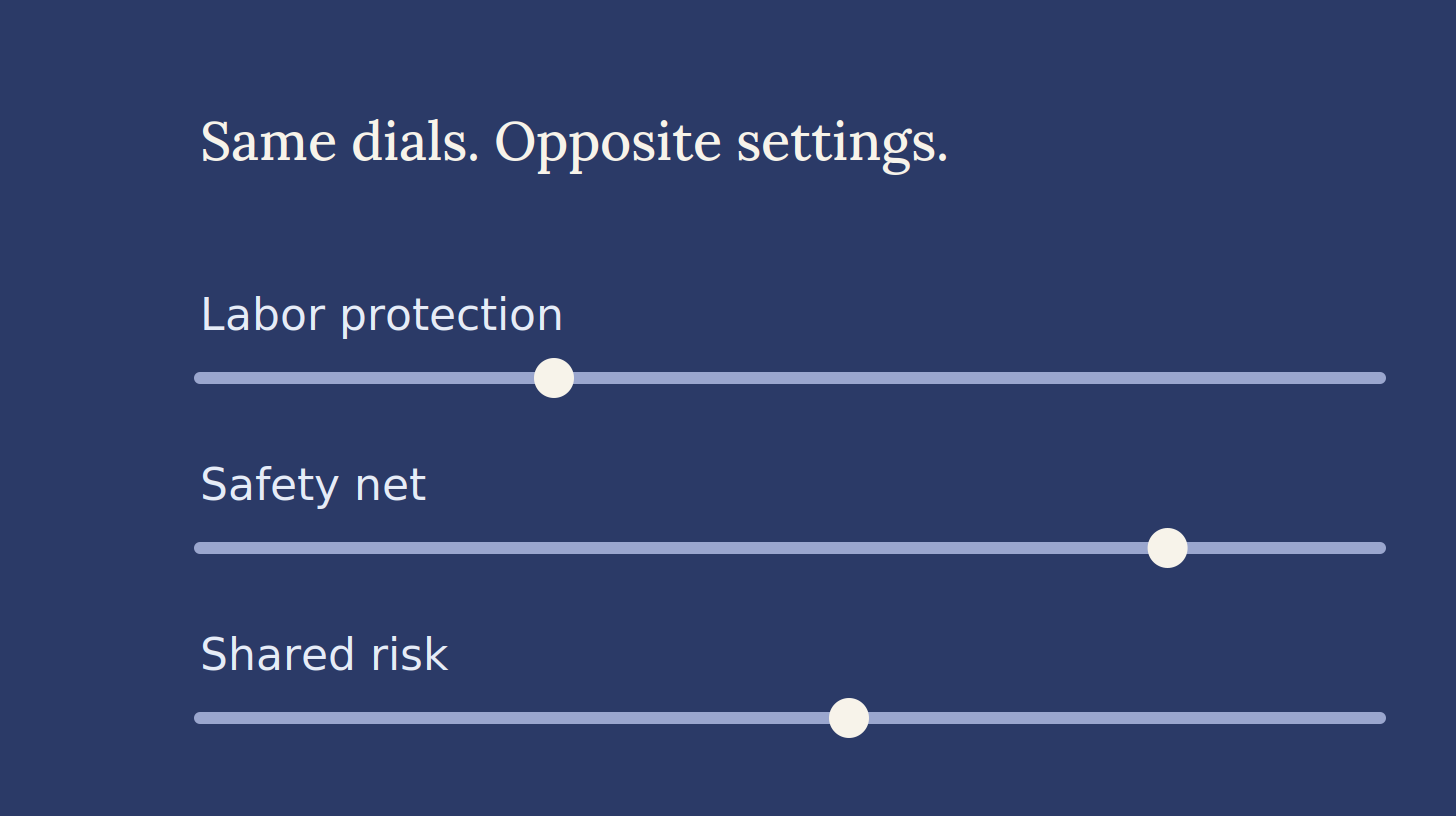
Same dials. Opposite settings. Two genuinely different places to be alive — and the difference isn’t national character or good luck. It’s where the controls were set, and by whom.
Hold onto one thing: none of these settings is a verdict about good and evil. A thin safety net is not wickedness, and a deep one is not virtue. Each dial buys something and costs something, and no dial works alone. Notice that easy firing looked like the opposite policy a moment ago, yet the labor dial sat in nearly the same place in both countries. What changed was everything around it. Pair easy firing with a deep safety net, portable healthcare and real retraining, and you get flexibility without fear. Pair the very same firing rule with a thin net and job-tied coverage, and it turns into exposure. That is the mirroring that matters: labor protection and the dials that catch people only mean something together. Read either one alone and you will misjudge the place. The skill is never in any single setting, but in how they are set against each other.
Underneath all of them sits one master dial, and it has a plain name: who carries the risk. No one sets it by hand. You read its position by adding up all the others — when something goes wrong, does the person carry it alone, does the company, or does society as a whole carry it together? Every smaller setting feeds this one. This is the dial the rest of this blog keeps circling back to, and almost no one ever chose it outright; it is the sum of all the others, most of them made discreetly enough that no one had to defend them out loud.
There are only a handful of these dials. The rest of this blog takes them one at a time — what each does, how it tends to be set, and what it would take to move it. You don’t have to memorize them. You just need to stop treating their settings as weather. The next time someone in power calls something simply the way things are (the job market, the price of getting sick, what happens to you if you fall), treat it as a claim to check, not a fact to accept. Find the dial. Ask who set it there, who it serves, and what it would take to move it.
Because it can be moved. That is the whole point of calling it a dial. Every one of these settings was put where it sits by people, in legislatures and negotiating rooms, over years; and what people set, people can reset.
Which leaves a sharper question to carry around than whether your country is a kind one: which way are your dials set, who benefits from keeping them exactly there — and who is going to reach over and move them?
Next: Society as a system — the habit of seeing the dials instead of blaming the people.