


Risk has to land somewhere, and labor law is the biggest single place a society decides where. It's usually treated as a technical subject, a matter of wages and hours and dismissal rules. It's better understood as a power balance — and as one of the main dials of a wellbeing society: the one that sets how much leverage a worker actually has.
Risk has to land somewhere argued that risk is allocated, not encountered. This essay turns to the most important instrument by which the allocation gets made.
Labor law is usually discussed as a regulatory subject. Wages, hours, safety standards, dismissal rules, anti-discrimination provisions. The conversation runs on policy detail, often technical, often legal.
The more useful way to look at it is as a power balance and as one of the main dials of the wellbeing society.
Balancing power
When an employer hires a worker, two parties enter a relationship in which one of them has substantially more leverage than the other. The employer controls access to the income and benefits the worker needs. The worker controls one input the employer needs — labor — but typically with fewer alternatives, less capital to wait out a stalemate, and more immediate consequences if the relationship ends. The asymmetry is structural. It exists before any specific employer or worker shows up.
Labor law is the system that sets the terms of that asymmetry. It can make the imbalance sharper, softer, or roughly balanced. It can give the worker a credible exit option or leave them stuck. It can let the employer adjust headcount in a week or require a year. It can require the employer to absorb the cost of disruption or pass it through to the worker. None of these are neutral defaults. All of them are choices.
This is the first thing to see about labor law: it is not background. It is the instrument that determines who has leverage, and how much.
The first tension: flexibility against protection
Labor law has more than one purpose, and the purposes do not always point the same way. The first and most familiar tension is between two of them.
The first is to grow the economic pie. When firms can hire, fire, restructure and experiment without prohibitive friction, they invest more readily. They take risks that produce new products, new sectors, new jobs. Labor markets that adjust quickly allow capital to move toward higher-return activity. From this angle, light labor law is a productivity tool. The economy benefits when adjustment is cheap.
The second is to protect employees. When workers are exposed to dismissal without recourse, to wage theft without remedy, to dangerous conditions without protection, to discrimination without standing, the imbalance becomes punitive. Stronger labor law constrains the firm’s freedom in order to give the worker some leverage. From this angle, robust labor law is a fairness tool. The worker benefits when the asymmetry is bounded.
These two purposes are not mutually exclusive, but they are often in tension. A rule that makes dismissal harder protects the worker who has the job and raises the cost of hiring new ones. A rule that gives the firm scheduling flexibility lowers labor costs and makes life harder to plan for the worker. Most consequential labor law sits somewhere in the trade-off space between them.
The question is not which of the two is correct. Both are. The question is how a given society calibrates between them — and whether the calibration is consistent with the rest of the system. The next sections name two further purposes that sit alongside this first tension: the leverage workers actually carry, and the role labor law plays as one dial in a larger architecture.
The leverage to say no
There is a purpose that labor law sometimes serves and sometimes does not: it can give workers real leverage, and break the link between holding a job and holding everything else.
Most workers do not depend on the employer only for wages. They also depend on the employer, in many systems, for healthcare, for retirement accumulation, for the legal status that allows them to remain in the country, and sometimes for the housing or schooling arrangements built around the work. The job carries far more than the work. When labor law is calibrated for worker leverage, it can begin to separate these strands — keeping the work inside the employment relationship and routing the rest through institutions that do not depend on any single employer. The worker is still the worker. But losing the job no longer means losing the things that have nothing to do with the work itself.
When labor law produces that kind of leverage, it produces something more specific than fair treatment in the workplace. It produces the capacity to say no.
Saying no, in this context, has several forms. It can mean refusing dangerous work without losing the job. It can mean joining a union without retaliation. It can mean asking for a raise, or for better conditions, or for the change of a policy that is not working, and continuing in the role afterward. It can mean reporting wrongdoing inside the firm — financial misconduct, harassment, safety violations — with legal protection against being fired for the report. It can mean leaving a bad employer for a better one without losing healthcare, retirement contributions, or family stability in the process.
Each of these is a kind of refusal. Each is structured by labor law, and several of them depend on the link-breaking the previous paragraph named. The right to refuse dangerous work is a specific legal provision in many countries. The right to organize and bargain collectively is a labor law question. Protection from retaliation against whistleblowers is a labor law question. The portability of benefits that lets a worker exit a bad job without catastrophic loss is partly a labor law question and partly a safety-net question — the two halves of the same allocation working together, or failing to.
When labor law is designed without attention to these capacities, the worker can technically say no in the same way someone can technically walk out of a burning building — the formal possibility exists, but the practical cost is high enough that almost no one does it. When labor law builds the capacity in deliberately, refusal becomes a real option, and the employment relationship becomes a negotiation between two parties with real choices, rather than one party choosing terms that the other can mostly only accept.
The argument is not that workers should be able to refuse anything. Firms have legitimate prerogatives. Discipline is real, including dismissal for cause. The point is narrower: in a wellbeing society, the worker’s ability to refuse without catastrophic consequence is itself a design choice, and labor law is one of the main places that choice gets made.
A dial in the wellbeing system
Labor law is one of the main dials of a wellbeing society. The earlier essays argued that most felt problems are design problems and that risk has to land somewhere. Labor law is the place where the largest single allocation of risk happens — the cost of ending or maintaining the employment relationship that most working-age adults spend most of their lives inside. It is also where the link-breaking just described either gets built in or quietly left out. Design this dial well, and many of the other dials become easier to set. Design it badly, and the others can do only so much to compensate.
This is also why the safety net keeps appearing in the argument. A society that calibrates labor law for high firm flexibility, and then builds no collective buffer to catch the workers being adjusted around, has not designed two systems. It has designed half a system. A society that calibrates labor law for strong employment protection without adjusting the safety net around it has built a different half. The configurations that work are the ones in which the two halves mirror each other coherently. Labor law alone cannot produce a wellbeing society. It is one of the foundational instruments, not the whole machine — and a later essay walks through what one specific country has built on top of this dial, before another returns to the safety net as the other half of the same picture.
Four calibrations
Different countries calibrate labor law differently. Four cases give the range.
Germany treats workers as participants in the firm itself. Employees have formal voice inside the company, dismissal is bounded by notice and consultation requirements, and the cost of ending a job is buffered by national infrastructure that does not depend on the employer. The worker has several different channels through which to refuse — inside the firm, through collective representation, through the courts, and through a labor market backed by deep collective protections.
Denmark takes the opposite route to the same destination. Dismissal is relatively easy. Hiring is also relatively easy. What catches the worker is the safety net: meaningful income replacement between jobs, publicly funded retraining, and active help finding the next role. The employer can let the worker go; the worker can leave; in either case the cost of the transition is shared rather than absorbed by the individual. This is the flexicurity logic. Refusal here runs through exit, and exit is survivable.
France concentrates protection in the employment relationship itself. Ending a job is costly for the firm, procedurally and financially. Workers who have a job are protected to a degree that is unusual internationally. The trade-off appears on the other side — firms are cautious about hiring because the cost of correcting a bad hire is high. Refusal in this system is real for the employed core and harder for everyone trying to enter it.
The United States runs the lightest of the four frameworks. The federal level establishes wage floors, basic safety rules and anti-discrimination law, and a formal right to organize. It does not guarantee paid leave of any kind, notice before dismissal, or severance. At-will employment is the default — workers can be terminated for any non-illegal reason. The substantive calibration is pushed down to the states, which choose very differently. A later essay walks through what those state-level choices actually look like.
These four are not the only calibrations. Sweden, the Netherlands, Italy, Japan and South Korea each have their own. But the four above span the meaningful range: voice inside the firm (Germany), flexibility caught by a deep safety net (Denmark), strong dismissal protection paid for by the firm (France), and a thin national framework with sharp state-level variation (the U.S.).
Each is a real configuration, currently operating. Each produces a different distribution of leverage. Each makes refusal possible in different ways.
The rest of these essays return to the U.S. case specifically. But the universal point is worth holding onto: labor law is not a regulatory subject. It is an instrument by which a society decides how much leverage workers have, how much risk they carry, and what they are able to refuse.
Closing
Labor law is the first place a society makes the choice about where risk lands and how leverage is distributed. It can be calibrated for adjustment speed, for worker protection, for the capacity to refuse, or for some combination of all three.
There is no neutral setting. Every choice produces different outcomes. The point is not that one calibration is correct, but that the choice is real, the trade-offs are visible, and the consequences flow predictably from what gets chosen.
A later essay turns to the U.S. as a worked example.
The dials in play
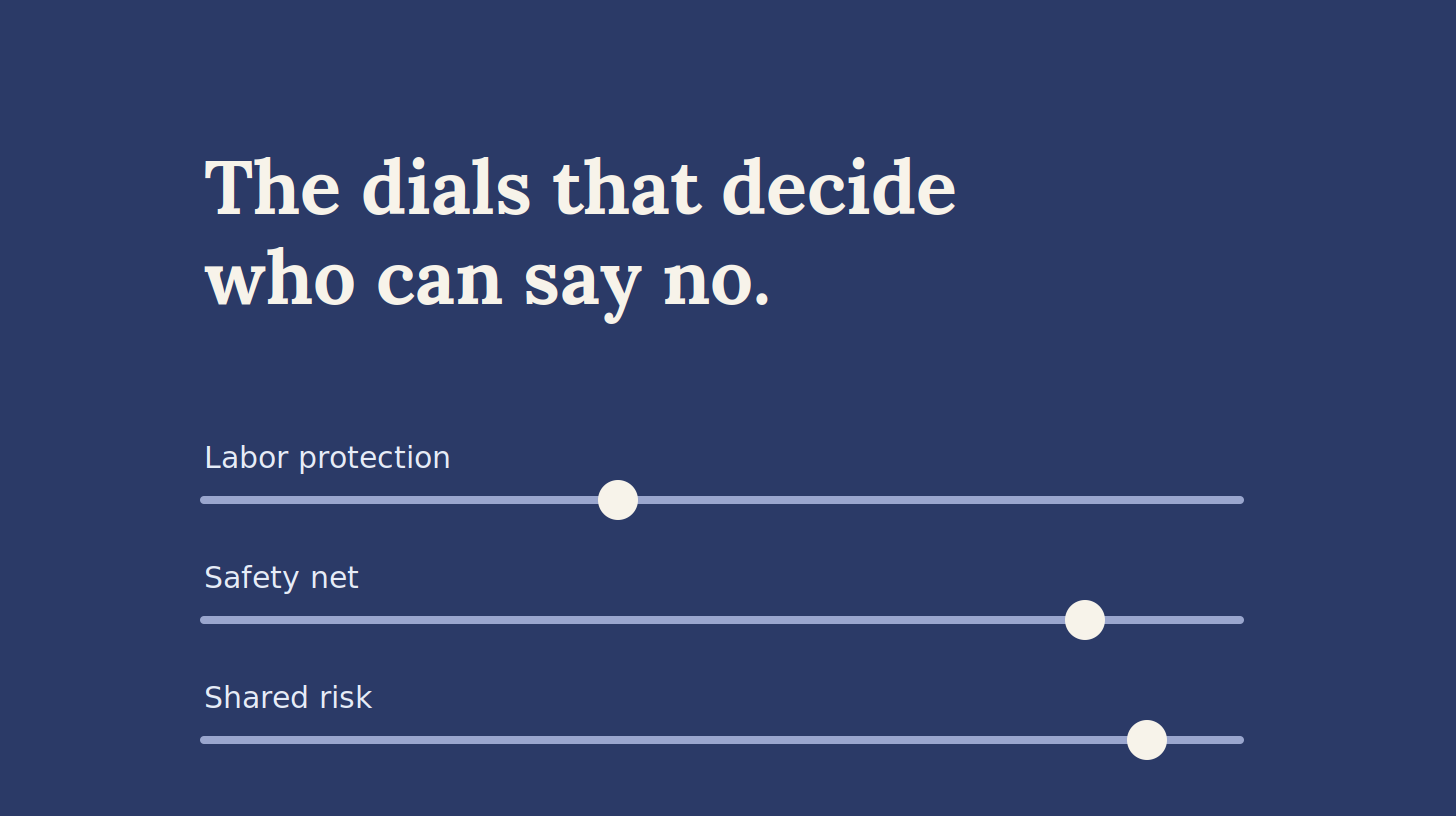
Labor protection (rigid ⟷ flexible) — sets how much leverage the worker carries inside the job. Toward rigid: those already employed are well shielded, but hiring slows and outsiders wait. Toward flexible: firms adjust and hire easily, but workers are exposed unless the safety net and portability catch them.
Safety-net depth (thin ⟷ deep) — the other half of the same allocation. Toward thin: a job loss becomes a personal spiral and the worker cannot afford to refuse anything. Toward deep: the fall is survivable, so leaving a bad job, organizing, or refusing unsafe work becomes a real option.
Risk allocation, the master dial (individual ⟷ firm ⟷ collective) — the labor-law and safety-net settings together decide who carries the cost when work ends: the worker alone, the firm, or the collective.
What to ask your representatives
Instead of asking whether our labor law protects the jobs people already have, ask: does it give a worker the leverage to refuse unsafe work, organize, or leave a bad employer without losing their footing?
Instead of asking how easily firms can hire and fire, ask: when a job ends, what catches the worker — and is it deep enough that the fall is survivable?
Instead of asking whether the economy is “flexible,” ask: when firms adjust, who ends up carrying the cost — the individual, the firm, or the collective?
New essays land every Tuesday — a later one turns to the U.S. as a worked example of how these dials get set. Subscribe to follow the thread.