


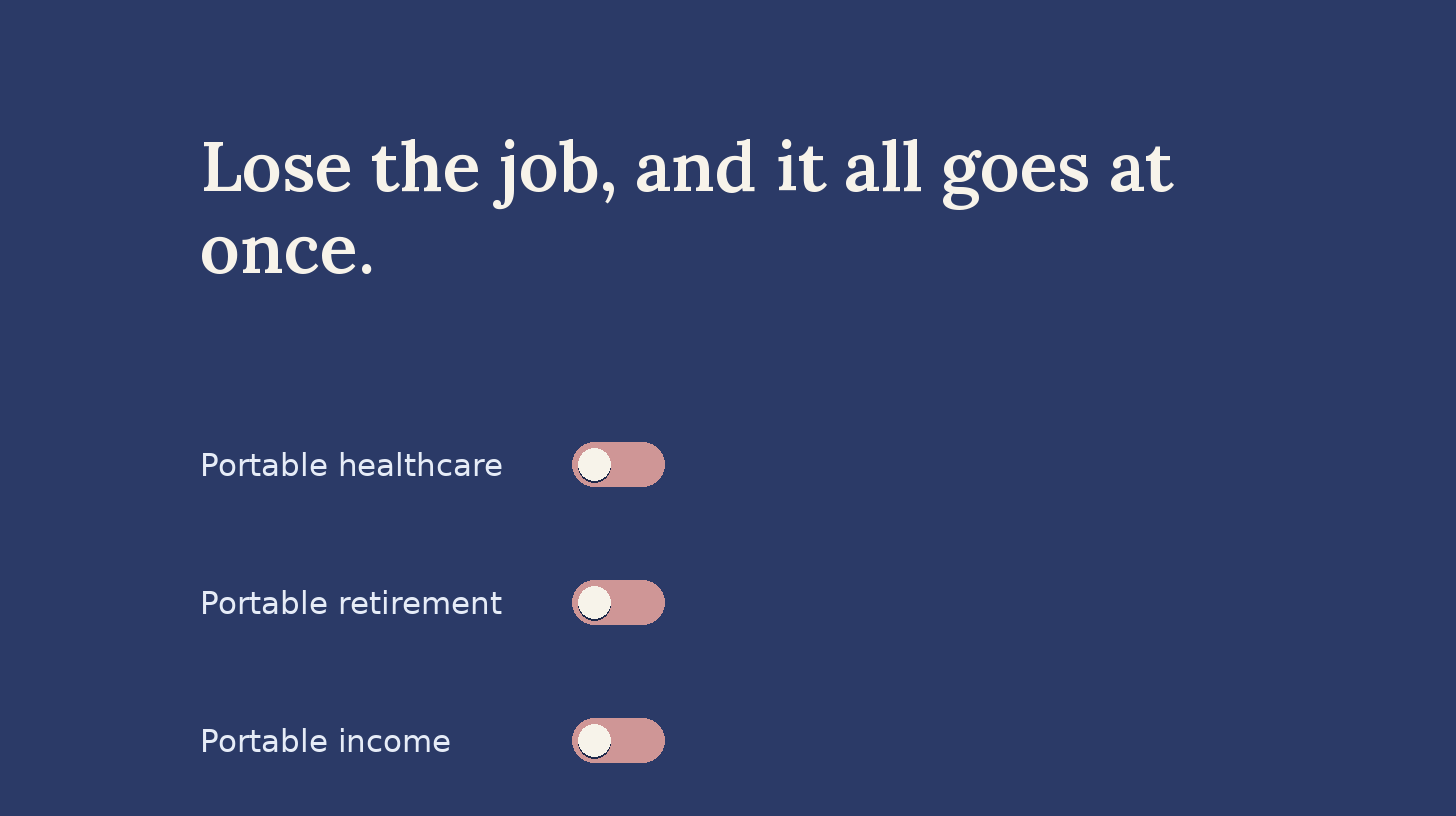
For most working-age Americans, a job is the source of far more than a paycheck. It carries the health insurance, the retirement savings and much of the household’s stability, and none of those travel with the person. They belong to the job.
Labor law and the safety net as mirrors set out two halves of one arrangement: the rules that govern how a job can end, and the supports that catch a person when it does. In the United States, both halves are set to keep costs low for employers, and neither covers for the other. This essay follows what that leaves behind in ordinary working life.
Risk that could be spread across several institutions is routed into a single relationship, between one worker and one employer. That relationship carries far more than a wage.
This is the narrow focal point of employment.
It was built that way, one federal decision at a time.
What a narrow focal point looks like
In most peer economies, the things a person needs in order to live — income, medical care, retirement, family support — are distributed across multiple institutions. Healthcare is provided through a public system or a portable insurance arrangement. Retirement combines public pensions with private savings. Family leave is mandated by national law. Unemployment insurance is funded and administered at the national level.
Each of these sits on its own pillar. When one weakens, the others continue to hold.
In the U.S., almost all of them have been bolted to a single relationship: the job.
Employer-sponsored health insurance covers most working-age adults. Retirement savings are accumulated primarily through employer-linked vehicles. Income depends on continuous employment. Family stability — childcare arrangements, school schedules, geographic stability — is structured around the work week. Even legal status, for many immigrants, runs through the employer.
When the job ends, several supports weaken at once. Not because each was designed to fail. Because they were all routed through the same channel.
The narrow focal point is what produces this cascade.
How the funnel forms
The funnel is not accidental. It is the cumulative result of a long series of decisions at the federal level.
Healthcare is the clearest case. The U.S. could have routed coverage through universal public provision, as most peer economies do. It did not. Instead, the federal government built tax preferences that subsidize employer-sponsored insurance, leaving the workplace as the primary access point for most working-age adults. The choice was made gradually, over decades, through tax policy rather than healthcare policy. The result is a healthcare system structured around employers.
Retirement followed a similar path. Defined-benefit pensions, once common at large employers, were largely replaced by individual retirement accounts tied to employment. Federal law created the framework. Employers became the platform. Workers became responsible for accumulating their own retirement security, inside a relationship that can end at any time.
Family stability followed the absence of policy. The federal government did not establish paid parental leave, mandatory paid sick days or universal childcare. In their absence, families negotiated these privately, mostly through the employer.
At each stage, the federal level chose not to build infrastructure. It chose to make the workplace the access point instead.
What this does to working-age adults
The result is a particular distribution of risk across the lifecycle.
For children, the U.S. provides public schooling and limited child-focused programs. For older adults, it provides Medicare and Social Security — both federally administered, both relatively robust, both decoupled from employment status.
In between, for the decades of working life, the federal floor is much lower. Healthcare, retirement, family stability and income protection are largely contingent on holding a job. The transitions that arrive in those decades — illness, layoff, parenthood, caregiving, retraining — happen in the period of life least protected by federal infrastructure.
This is a striking pattern. The same federal government that guarantees coverage at the beginning and end of life leaves the middle largely to the employment relationship. The exception proves the rule. The U.S. knows how to design federal continuity. It chose not to apply that design to working-age adults.
What the funnel does to leverage
The narrow focal point also reshapes the employment relationship itself.
When negotiation between a worker and an employer concerns wages or working conditions, both sides operate with comparable kinds of leverage. The worker can leave. The employer can hire someone else. The exchange is unbalanced — firms have scale and lawyers — but the terms are economic.
When the same relationship also determines healthcare, retirement and family stability, the worker’s leverage collapses. Leaving the job means losing more than income. It can mean losing access to medical care, interrupting retirement contributions, destabilizing childcare arrangements, and in some cases losing legal status.
What collapses, specifically, is the worker’s ability to say no. The previous essay named the right to say no as one of the things a labor system can be calibrated to produce. The narrow focal point does the opposite. It makes refusal expensive enough that workers stop using the formal options they technically have.
Four kinds of refusal are most affected.
The ability to say no to bad working conditions. A worker who needs the healthcare more than they need the moral high ground will accept conditions they would otherwise refuse. The harder the conditions are to leave, the more conditions can be imposed without resistance.
The ability to join a union. Organizing efforts in the U.S. face significant friction even where federal law formally protects them. When healthcare, retirement and family stability all run through the employer, the cost of being identified as an organizer rises sharply. The penalty is not only the legal one; it is the loss of everything else the job carries.
The ability to ask for change. Annual reviews, internal escalations, requests for new arrangements all happen against the implicit knowledge that the relationship can end at any time with cascading consequences. The reasonable worker asks for less than they would in a system where exit is survivable.
The ability to be a whistleblower. Reporting financial misconduct, harassment or safety violations carries real career risk in any labor market. In a system where reporting can also mean losing healthcare for a child or interrupting retirement accumulation in the worker’s fifties, the cost rises further. Many wrongdoings go unreported because the structural cost of reporting them is borne by the person who reports.
Each additional dependency tightens the funnel. Workers become less able to negotiate, change jobs, or refuse unfavorable conditions — not because alternatives are absent, but because the personal cost of transition is too high.
This produces an outcome the surface of the system does not advertise. The U.S. economy looks highly flexible in aggregate — workers do change jobs, do move, do take risks. But many of those moves happen under conditions of constrained leverage, where the price of exit is high enough to keep most workers in place even when better options exist elsewhere.
The funnel does not eliminate movement. It taxes it. And it raises the price of saying no high enough that, most of the time, the answer is yes.
How the funnel compounds
The narrow focal point also produces a particular kind of inequality.
For workers in stable, well-compensated jobs at large employers, the funnel is mostly invisible. Healthcare, retirement contributions and family benefits arrive without much friction. The single point of failure is unlikely to break. From inside that arrangement, the system looks like it works.
For workers in less stable jobs — part-time, contract, low-margin sectors, smaller employers — the funnel is constantly visible. Coverage is partial or absent. Retirement contributions are missing. A single disruption produces a cascade. The same single point of failure breaks regularly.
Over time, this produces divergence. Workers inside the protected core can plan, save, recover from setbacks and invest in their futures. Workers outside it absorb each shock individually, often without recovery. The cumulative gap is not a function of effort. It is a function of which side of the funnel the job sits on.
The design implication
A wellbeing-oriented system would not necessarily eliminate the workplace as a source of benefits. It would decouple the most critical ones — healthcare, retirement continuity, basic income protection during transitions — from any single relationship.
Healthcare would follow the individual. Retirement would accumulate in portable vehicles with predictable rules. Unemployment insurance would replace enough income for long enough that transitions did not become cliffs. None of this would prevent employers from offering additional benefits, or workers from negotiating better terms. It would only ensure that the loss of a job did not mean the loss of everything else.
This is the difference between a system that places risk on individuals and one that distributes it across institutions. Both can be flexible. Both can be productive. Only the second leaves the worker with leverage.
Closing
The narrow focal point of employment is the central design feature of the U.S. wellbeing system. It is what makes losing a job a much larger event than losing a job. It is what hollows out worker leverage even in tight labor markets. And it is what makes the difference between protected and exposed workers compound across decades.
The funnel is not the only design choice the U.S. has made. It is the one that determines how all the others land.
The dials in play
Healthcare (employer-tied ⟷ universal). The U.S. bolts coverage to the job, so losing work loses care — the single biggest dependency in the funnel.
Portability of security (job-tied ⟷ follows-the-person). Retirement and income protection run through the employer too, so one exit interrupts several pillars at once.
Risk allocation (individual ⟷ firm ⟷ collective). The master dial: funneling every need through one relationship lands the whole risk on the individual — and quietly strips their leverage to say no.
What to ask your representatives
Instead of asking how to protect jobs, ask: what happens to a person here when the job ends — and how many of their protections end with it?
Instead of asking whether benefits should come from employers, ask: which protections should follow the person instead, so losing a job isn’t losing everything?
Instead of asking why workers don’t speak up, ask: how expensive have we made saying no — and who pays that price?
Love the way your essay concisely defines the parameters of the US workplace environment, and then translates the disadvantages workers have compared to employers into questions to ask your representatives. It exposes the structural inequities built into a system that leaves workers changing jobs vulnerable not only for the loss of a paycheck but also for disruptions to healthcare, retirement benefits, and workplace protections. The corrosive effect of this dynamic will play out at scale when job displacement from AI fully ripples through the economy. This is at the core of the affordability message that progressive democrats are making. Let's hope that polls showing the effectiveness of this message actually translates into a massive blue wave that, in turn, begins to remedy this corrosive dynamic.