


Most economic debates assume a choice: protect people, or let the economy perform. You don’t have to choose. The strongest results come from having both, because each makes the other work. What decides it is where the protection sits.
The intuition behind the exchange is easy to follow. A worker who is hard to dismiss is expensive to hire. A safety net that pays people while they are out of work seems to weaken the reason to find the next job. Every protection looks like a cost, and every cost looks like drag on growth.
Part of that is true. Labor protection, the set of rules that makes dismissal slow and costly, does make firms more cautious. Economies built mainly on those rules adjust more slowly. But job protection is only one place to put security. Security can also sit outside the job: in a safety net that holds income steady between roles, in healthcare and retirement that follow the person, and in support that helps people retrain and move into their next position.
Where the security sits changes what it costs. When it is locked inside the job, it either slows the economy down or disappears when the job ends. The narrow focal point of employment in the United States traced the second case. When security is carried by buffers outside the job, firms can adjust quickly and people can move without falling far.
This essay puts those pieces together. It argues that a well-designed wellbeing society supports economic performance, in many cases more than the alternatives do. A real trade-off does exist, but it is narrower than the debate assumes and it sits somewhere else. Before making that case, it helps to be clear about what performance means.
What economic performance is
When economists talk about economic performance, they usually mean some combination of productivity, output, dynamism and innovation. Productivity is how much value the economy produces per hour of work. Output is total economic activity. Dynamism is the rate at which capital and labor reallocate to better uses. Innovation is the rate at which the economy produces new products, services and processes.
A high-performing economy does well across these dimensions. It uses its labor effectively. It generates wealth. It adjusts when conditions change. It produces new things.
It is worth noticing that none of these measures is the same as workers feeling secure. In principle, an economy could perform well by extracting maximum effort from a workforce that has no margin for error, no exit options and no protection against shocks. The intuition that protection trades off against performance comes from this picture: workers who can leave easily produce less; firms that cannot dismiss easily invest less; safety nets that catch people reduce their incentive to keep working.
The picture has some truth in it. But it leaves out most of what determines whether an economy actually performs.
Why wellbeing supports performance
The countries usually held up as wellbeing societies — Denmark, Sweden, Finland, the Netherlands, Germany in many respects — are not economic laggards. They sit near the top of global rankings for productivity, innovation and competitiveness. Several have higher rates of business formation per capita than the United States. Several have larger global companies relative to their populations. These are not exceptions; they are evidence.
A few mechanisms explain why.
When workers have leverage — real exit options, durable security that does not depend on any single employer — the labor market reallocates better. Workers move toward employers who actually need them and away from employers who are wasting their time. The matching improves. Productivity rises because more people are doing work that fits them.
When falling is survivable, people take more constructive risks. They start businesses, switch careers, retrain into new sectors. Each of these is a transaction the dynamic part of the economy needs to happen. Societies that make those transactions safer get more of them. Innovation depends on this.
When background stress is lower, cognitive bandwidth is higher. Workers under constant low-grade survival stress make worse decisions, miss more days, produce worse work, turn over more often. The productivity tax of insecurity is real and large — not by a small margin in the well-documented cases. A workforce that can plan beyond the next month is, in aggregate, more productive than one that cannot.
When healthcare follows the person and retirement is portable, the labor market is more mobile. People who would otherwise stay in jobs that fit them poorly can move. Firms can hire workers who chose to be there rather than ones who happen to be trapped.
These mechanisms compound. The wellbeing-oriented economies do not happen to be productive in spite of their safety nets. They are productive in part because of them. The trade-off framing has the direction wrong.
What actually trades off
There is a real trade-off in this domain, but it is not between wellbeing and performance. It is between security and flexibility.
Protecting workers from being fired makes labor markets less responsive. Heavy dismissal protections produce labor markets where workers inside the protected core are very secure and workers outside it have a harder time getting in. France and Italy show variants of this. The protection is real; the trade-off is real.
Lighter dismissal rules combined with deep safety nets and active transition support produce a different outcome — labor markets that adjust quickly and workers who land somewhere when they have to move. Denmark calls this flexicurity. High flexibility, high security, with security distributed across institutions rather than tied to any single job.
Both configurations can produce high performance and high wellbeing. The flexicurity model tends to score slightly higher on dynamism; the heavy-protection model tends to score slightly higher on income stability for those inside the system. Both are real choices, with different trade-offs.
The configuration that consistently underperforms is light flexibility and light security at the same time. That combination produces an economy that looks dynamic in aggregate but burns through individual buffers to keep it that way. Many workers operate without margin for error. The labor market reallocates, but much of the movement is driven by desperation rather than choice. Background stress is high. Innovation suffers because experimentation requires margin. The U.S. is the most prominent example of this configuration.
This is where the wellbeing-performance argument lands. Performance and wellbeing are not opposed. The two halves of the labor architecture — flexibility and security — are the trade-off. Get the calibration of those two right, and both performance and wellbeing follow. Get the calibration wrong, and both deteriorate.
The five variables
Five variables determine how a society distributes risk and what its wellbeing-performance balance produces. These are introduced in detail in the previous essays; the brief versions here are reminders, not introductions.
Labor market flexibility is how easily firms can hire, dismiss and restructure. The product of labor law, mostly. High flexibility allows fast adaptation. Low flexibility allows long-term commitments. Neither is automatically better.
Safety net depth is how much protection exists when income is disrupted. Unemployment insurance, healthcare access, basic income support. Deep safety nets absorb shocks at the collective level. Thin ones force individuals to carry the volatility directly.
Portability of security is whether core protections follow the person or remain tied to a specific job. Low portability raises the personal cost of changing jobs. High portability lowers it. The two most important protections here are healthcare and retirement.
Transition support is how effectively the system helps people move between roles. Retraining, job matching, income continuity during transitions. Weak transition support makes unemployment harden into long-term exclusion. Strong transition support makes movement survivable.
Risk allocation is where the cost of shocks actually lands — on individuals, firms, or the collective. This is the calculated outcome of how the first four are tuned, not a separate dial. Labor law determines how adjustment happens. The safety net determines how shocks are absorbed. Portability determines whether movement is punished or enabled. Transition support determines whether recovery is passive or active. The placement of risk falls out of these settings.
The point of the framework is that the five variables interact. No single one is sufficient. Calibrating one without the others produces dysfunction — sometimes more dysfunction than not changing anything at all.
What alignment produces
When the five variables are calibrated to mesh, adjustment happens quickly on both sides of the market. Firms adapt. People move. Matching improves. Productivity rises.
This is not the absence of risk. It is risk that is distributed across institutions rather than stacked on individuals. The economy still adjusts. People still face disruption. But disruption does not cascade into long-term damage, because the system is designed to catch and redirect, not just to absorb.
Sweden is the standard example. Labor law allows firms to restructure, reduce headcount and reorganize. The safety net catches workers between jobs, healthcare continues regardless of employment, retraining is publicly funded, and matching back into work is supported. The result is speed without desperation: adaptation without panic, flexibility without precarity, movement without fear. The economy performs. The workers are protected. Both are outcomes of the same calibration.
The U.S. configuration sits at the other end of the coherence spectrum, but in a different way than France or Italy. Labor law is permissive. The safety net is partial and state-divergent. Security is largely tied to employment, which keeps portability low. Transition support exists but is fragmented and uneven. Risk lands on individuals, and the cascade described in the previous essays follows. The economy is dynamic, but the dynamism is paid for by individual exposure.
France sits at yet another point. The safety net is deeper. Failure is buffered. But labor law makes adjustment costly enough that hiring is treated as a long-term commitment, so firms hire less readily. Workers inside the system are protected; workers outside it struggle to enter. Protection is real; velocity is low.
None of these configurations is inherently right or wrong. Each represents a different choice about how to calibrate the variables. What they share is that the calibration is consequential, and the consequences are visible.
The price of a system that works
There is one more argument worth making, because it sits underneath most of the political resistance to wellbeing systems.
A common objection to deep safety nets is that some people will abuse them. Some unemployed workers will not look hard for the next job. Some recipients of paid leave will take it for reasons that are not strictly necessary. Some welfare recipients will game the rules.
This is true. It is also the price of a system that works.
Every system that delivers benefits at scale operates with some level of misuse. Amazon knows that some packages get lost in transit, some customers game the return policy, some people order items they have no intention of keeping. Amazon offers free delivery anyway, because the alternative — making every customer prove they deserve the benefit before receiving it — would impose costs on every transaction that exceed the costs of accepting a small amount of misuse. The math works because the friction of perfect screening is more expensive than the friction of imperfect delivery.
The same math applies to safety nets. A system that requires every recipient to prove deservingness before receiving anything imposes costs on every recipient. Most of those recipients are not gaming the system. They are workers in transition, parents in family disruption, people dealing with illness, individuals in the gap between roles. The screening cost lands disproportionately on the people the system was built to help, while doing relatively little to deter the small minority who do try to game it.
A well-designed wellbeing system accepts some level of misuse as the cost of broad and frictionless access. The cost is real but bounded. The benefit — a workforce that can take risks, change jobs, recover from setbacks — is large and broad. The arithmetic is the same as Amazon’s. Accept the leakage; deliver the benefit at scale; come out ahead.
This is not an argument against guarding against fraud. It is an argument against using fraud-prevention as the organizing principle of safety net design. Systems that obsess over preventing all misuse end up doing very little of the work they were built to do.
Why this matters
The argument of this essay is one claim, expressed in several ways.
Wellbeing and performance are not opposites. Most failures in this domain are not ideological. They are design mismatches. High flexibility without buffering produces stress and underperformance. High protection without flexibility produces stagnation. Alignment produces speed with recoverability.
The question for any society is not whether to choose wellbeing or performance. It is whether the variables are tuned to allow both. That is a design question, not a values question. Once it is framed that way, the political conversation changes. The debate is no longer between protection and growth, or between solidarity and dynamism. It is about which variable is out of alignment, and what would have to change to bring the system back into balance.
Closing
A functioning economy needs people who can adapt. A wellbeing society makes that adaptation possible.
The wellbeing-performance balance is not about choosing one over the other. It is about designing systems where performance does not rely on individual fragility, and wellbeing does not require stagnation.
Balance is not compromise. It is competence.
The dials in play
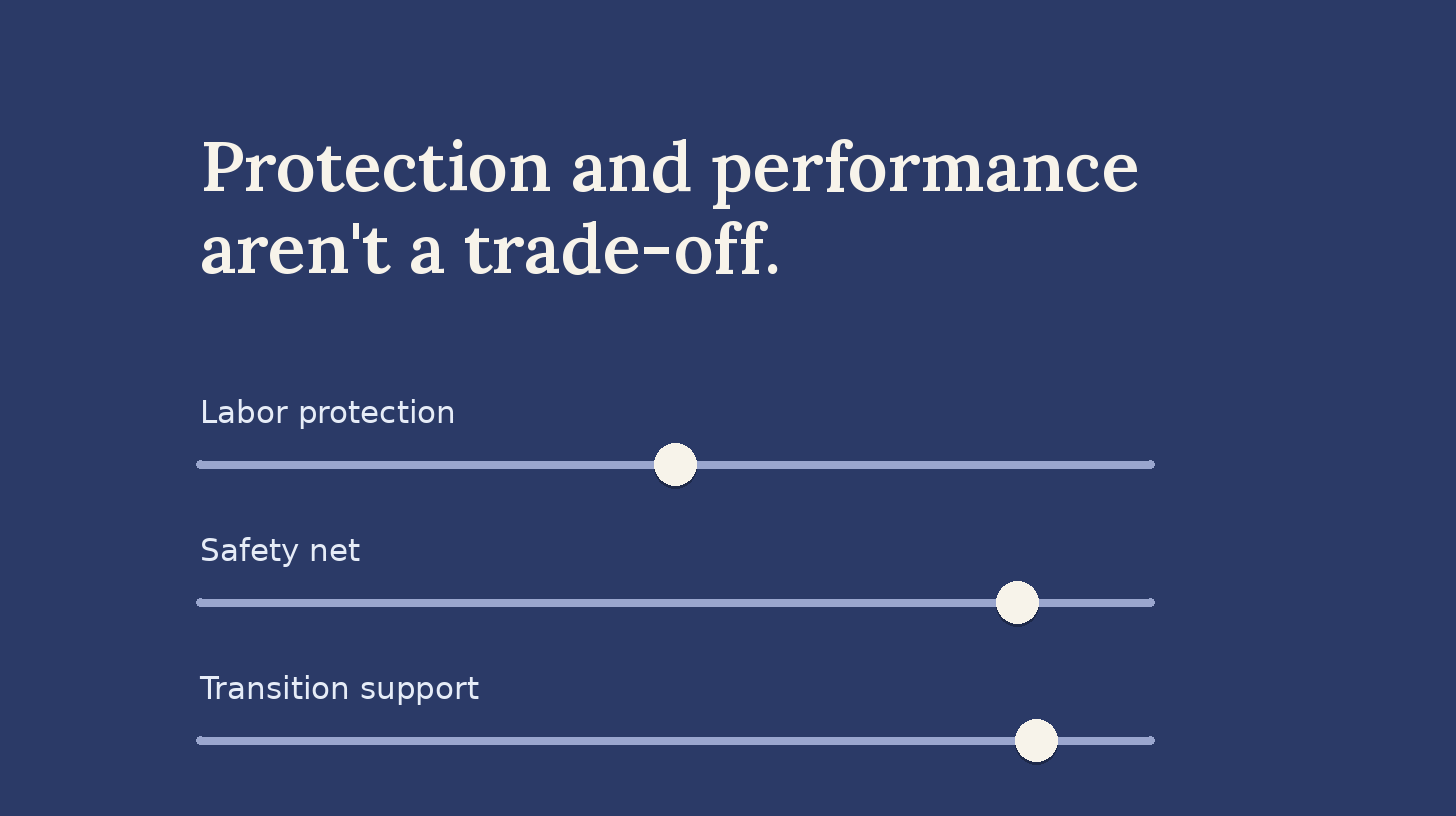
Labor protection (rigid ⟷ flexible). The real trade-off isn’t wellbeing vs performance — it’s flexibility vs security. Protection can sit toward flexible, but only if the buffers below are deep.
Safety-net depth (thin ⟷ deep). Deep buffers are what make a flexible labor market survivable; flexibility plus a thin net — the U.S. case — is the one configuration that consistently underperforms.
Transition support (passive ⟷ active). Active retraining and re-entry turn movement into matching instead of desperation — speed without panic.
What to ask your representatives
Instead of asking whether to choose growth or protection, ask: which of our labor dials is out of alignment — and is flexibility being carried by buffers, or by individual fragility?
Instead of asking how to stop people gaming benefits, ask: is fraud-prevention the organizing principle of our safety net — and what does that screening cost the people it’s meant to help?
Instead of asking whether security slows the economy, ask: would deeper, portable buffers let more people move toward work that actually fits them?