


Mobility is usually discussed either as a moral question — is it fair that some rise and others do not — or as a country-level statistic, the way the World Bank or OECD reports it. Neither framing reveals what produces mobility.
Mobility is a design outcome. The design has named dials.
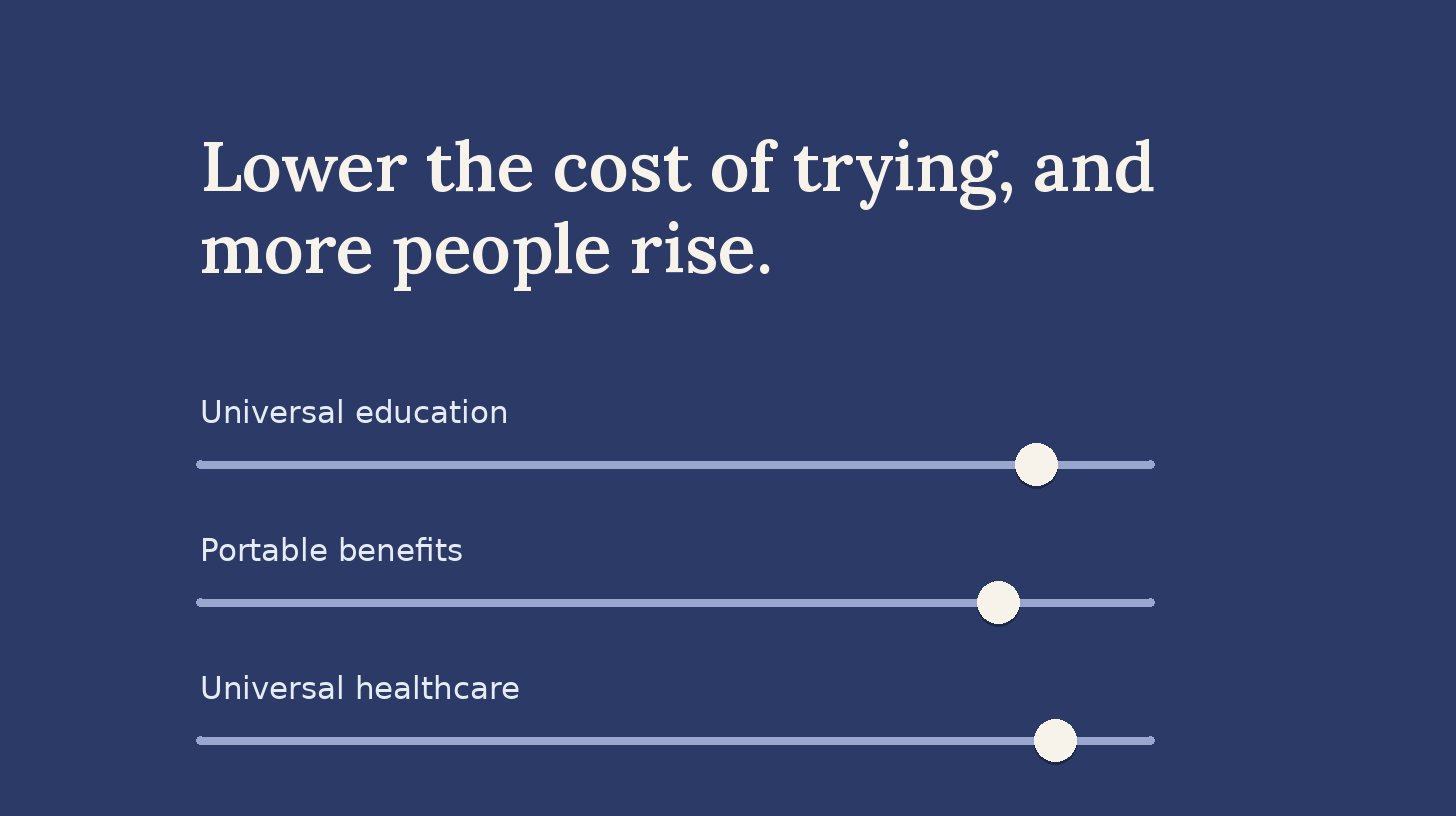
When a society reads as mobile, it is because most of its dials are turned in roughly the same direction. When a society reads as stratified, most of its dials are turned the other way. The dials themselves are recognizable. They can be named and read in any society, regardless of how the society talks about itself.
The principle underneath is simple. Mobility is what happens when the cost of trying is low enough across the population that effort and judgment can compound. Every building block reduces some specific cost of trying. Every blocker raises one. A society’s mobility is approximately the sum of those settings.
This essay names the dials. The first half names the building blocks — six design choices that, when set, produce mobility broadly. The second half names the blockers — five design choices that, when present, suppress it.
Six building blocks
Universal early education
The earliest dial. Children who arrive at age five or six already differ in vocabulary, in numeracy readiness, in the soft skills schools assume rather than teach. Those differences are largely the product of what surrounded them in the first five years. When universal early education is available — affordable, broadly even in quality, treated as infrastructure rather than as a luxury — the gap that family of origin produces is smaller by the time formal schooling begins.
This is the dial that most directly determines whether mobility starts from approximately the same line for most of the population, or from very different lines depending on what household a child was born into. It is also the dial that pays back over the longest horizon, which is why it tends to be underfunded in systems with short political horizons. The economics of early-childhood investment are well documented; the politics rarely catch up.
Education access through to university
If the education system is broadly even through secondary school, but university is gated by family wealth — through fees, through debt, through geographic access — the credential filter becomes an inheritance filter. The cost of the degree determines who can afford to acquire it, and the degree then determines who can afford to compete for the roles that require it.
Mobility-supporting education access is not free higher education in every society. The dial has several settings: free or low-cost tuition, public funding of living costs, manageable repayment systems, geographic distribution that does not require relocation, vocational paths that carry comparable legitimacy. What matters is whether the next stage of education is affordable for a student whose family cannot pay for it.
When affordability fails at this stage, talent that cannot pay does not reach the credential. The filter then sorts not by capacity but by who could afford to be sorted.
Healthcare that follows the person
In systems where healthcare is tied to a particular job, every job change is a healthcare decision. Every period of unemployment is a healthcare risk. Every move from a large employer to a small one, from employment to self-employment, from one industry to another, carries a healthcare cost that has nothing to do with the work itself.
Portable healthcare — coverage that follows the person across jobs, fields, and life phases — removes that cost. The work decisions become work decisions. The risk of trying something new is bounded by the risk of the thing itself, not amplified by the healthcare system attached to the old role.
This is the single largest mobility dial in many systems because healthcare costs are large enough that losing access changes how people make every other decision. In systems where it is portable, this dial recedes into background. In systems where it is not, it dominates.
Retraining and re-entry infrastructure
The mobility a society produces is partly the mobility it allows late in life. A society where credentials lock trajectories before thirty has a different mobility profile than one where someone can retrain at forty-five or fifty into a different field and re-enter productive work without starting at the bottom.
Retraining infrastructure includes accessible adult education, transition support that lasts long enough to learn something useful, employer expectations that do not treat a forty-five-year-old career-changer as a risk, and credential systems that recognize learning acquired outside the original pathway. Re-entry infrastructure includes job-matching that does not penalize gaps, employer practices that consider candidates whose previous role was different, and a social context in which mid-career change reads as adaptation rather than as failure.
This dial determines how long the productive working population effectively is. A society that turns it well has more working years per person, which matters under demographic pressure. A society that turns it poorly throws away decades of capacity from people who could still contribute but cannot find the path back.
Labor law that doesn’t tie security to one employer
Labor law shapes whether security is something the worker carries or something the employer holds. When the employer holds it — through job-tied healthcare, retirement contributions, parental-leave provision, even housing through company-linked arrangements — leaving the employer is leaving the security. The cost of exit is the cost of trying something new.
When the employer does not hold it — when the worker can change jobs without losing healthcare, can take a year off without retirement contributions resetting, can negotiate from a position where the employment relationship is one piece of the picture rather than the whole picture — mobility within the labor market becomes possible.
The labor law of a wellbeing society develops this dial in full. The narrow focal point of employment in the United States shows what happens when the dial is turned the other way and a single employment relationship becomes the channel through which most security flows. The U.S. case is the most legible example of how much mobility this dial alone can suppress when it is set against the worker.
A safety net that buffers transitions
The final building block is the one that makes the others coherent. A safety net that buffers transitions — income support that lasts long enough for retraining to work, housing assistance that prevents an income shock from cascading into instability, family support that does not disappear at the first earnings loss — is what makes the cost of trying bounded.
Without this dial, every other building block is partial. Universal education matters less if a single layoff still cascades into homelessness. Portable healthcare matters less if income loss still destroys a household’s stability. Retraining infrastructure matters less if no one can afford the months it takes to use it.
Failure-survivability is the precondition for risk-taking from a wide base. The safety net is the dial that produces it.
Five blockers
Class society
Some of the things that block mobility are not legible as design dials because they operate through implicit signaling. Accent. Name. School history. The networks people inherited and the ones they did not. The behaviors that read as confident in some rooms and out-of-place in others.
These are not policy variables. They cannot be legislated away. But they shape outcomes consistently: the same résumé reads differently depending on which school is on it; the same idea is taken more seriously from one speaker than another; the same mistake is forgiven in one person and remembered in another. Over a career, these small variations compound into very different trajectories.
A class society is one in which these implicit signals carry enough weight that effort and judgment cannot fully override them. The dial cannot be turned directly. It can be reduced by widening the building-block dials — when more people from more backgrounds reach the rooms where the signals are read, the signals lose some of their discriminating power. But the dial does not move quickly, and societies that do not name it operate as though it were not there.
Expensive education
The most direct mobility-killer in many modern systems. When higher education requires substantial debt, the decision to acquire the credential becomes a wealth-dependent calculation rather than a capacity-dependent one. The talent that takes the debt commits to repayment schedules that constrain career choices for years afterward. The talent that does not take the debt does not get the credential. Either way, the financial gate sorts who enters the trajectory.
Debt is the specific mechanism worth naming. Debt-financed education shapes mobility not only at the gate but for years after. People with significant student debt cannot afford to take low-paying roles that lead somewhere, cannot afford gaps for retraining, cannot afford the slower-but-better-fit career path that requires several modest-income years upfront. The debt narrows the choices the credential was supposed to open.
This dial interacts strongly with the early-education and tertiary-access dials. A society can have generous early education and still block mobility at the university stage by pricing the gate too high. The blocker undoes some of what the building block produced.
Structural racism
The historical and ongoing pattern by which background is read by race and outcomes are shaped accordingly. The mechanism is the same one that operates through class signaling, but it is more legible, more persistent, and more often institutional.
Structural racism is the version of this mechanism where the unequal starting point is racial. It blocks mobility from generation to generation, even when explicit barriers are removed, because the system is designed to preserve what it inherits. The blocker is structural in the precise sense — it operates through the architecture of the system, not only through the attitudes of the people inside it.
Employment-tied protection
The inverse of the labor-law and healthcare-portability dials, named separately because the combination is what does the damage. When healthcare, retirement, family stability, and often housing security all flow through a single employment relationship, that relationship becomes the channel for almost everything that matters. Changing it is too risky for most people to attempt, and the labor market loses much of the movement it would otherwise contain.
The U.S. case is the canonical example. The narrow focal point of employment in the U.S. concentrates security so tightly around the job that mobility within the labor market is suppressed for people who cannot absorb the risk of losing the bundle. The blocker is severe enough that several of the building blocks above are partially overridden by it: portable retraining infrastructure helps less when leaving the current job means losing the family’s healthcare; education access helps less when the credential gates jobs that themselves bundle the security.
Wealth as structurally-advantaged trajectory
The top-side blocker. Wealth is not the problem; the wellbeing-society design depends on income differences that reward effort. The blocker is what wealth is allowed to buy.
When wealth buys comfort, choice, and security, that is what success is for. When it buys preferential access to education that others cannot reach, insulation from the consequences of failure that no one else gets, exemption from rules everyone else operates under, and trajectories that are reserved for the already-positioned, it begins to suppress mobility from the other end. Each generation that inherits one of these structural advantages starts from a different line than the rest of the population. The compounding goes the same way it would in any other unequal-starting-point system.
The dial here is not the existence of wealth but the rules about what wealth can purchase that shape trajectories. Education systems that admit by capacity rather than by donation. Legal systems that apply the same rules to high-wealth defendants as to others. Tax systems that do not produce structurally lower effective rates for those who hold the most. Each of these adjustments turns the top-side mobility dial back toward the building-block direction.
What this implies
The dials interact. No single building block produces mobility on its own. No single blocker shuts it down completely. But combinations matter, and combinations are what societies actually have.
A society with universal healthcare and expensive education does not get the mobility a society with both produces. A society with strong retraining infrastructure but employment-tied protection finds the retraining underused, because the cost of acting on it is too high. A society that turns most building-block dials well but does not name its class society finds the building blocks producing less mobility than they should, because the implicit signals are doing work no one is measuring.
The wellbeing-society design is the configuration that turns most of the dials in the building-block direction at once. This is what makes it produce the mobility it does. It is not that any single feature of the design is magic. It is that the features reinforce each other, so that the cost of trying drops on multiple axes at the same time. The compounding works in the right direction.
Conversely, the configurations that produce stratified societies are the ones where multiple blockers are present together. Expensive education plus employment-tied protection plus structural racism plus an unnamed class society plus wealth as structurally-advantaged trajectory: this is not a hypothetical society. It is a recognizable one. Its mobility outcomes are predictable from its dial settings.
The point of naming the dials is not to prescribe a single configuration. Different societies will turn them differently, and the wellbeing society is itself a family of configurations rather than a single template. The point is that the dials are recognizable. A society can be read by where it has set them. So can a political program proposing to change them.
Closing
Mobility is not luck and it is not cultural temperament. It is the outcome of how a society has set a small number of design dials.
The building blocks are the dials that lower the cost of trying — universal early education, education access through to university, healthcare that follows the person, retraining and re-entry infrastructure, labor law that does not tie security to one employer, a safety net that buffers transitions. The blockers are the dials that raise it — class society, expensive education, structural racism, employment-tied protection, wealth as structurally-advantaged trajectory.
When the dials are set the wrong way, the population reads the signals and responds. The response is rarely loud. The next essay reads what blocked trajectories produce — at the population level, where people withdraw, and at the system level, where the costs compound against the financing the wellbeing society depends on.
The dials in play
Education access (wealth-gated ⟷ universal). The earliest and largest lever: when early education and university don’t depend on family wealth, talent reaches the credential instead of only those who can pay.
Portability of security (job-tied ⟷ follows-the-person). When security follows the person, changing jobs or retraining stops costing the worker everything — so movement happens across a wider base.
Healthcare (employer-tied ⟷ universal). Coverage that follows the person removes the single largest cost attached to trying something new.
What to ask your representatives
Instead of asking why some people don’t get ahead, ask: which of our design choices raise the cost of trying — early education, tuition, job-tied benefits — and for whom?
Instead of asking whether college should be free, ask: does the next stage of education sort by capacity, or by who can pay?
Instead of treating mobility as character, ask: are our dials set to lower the cost of trying across the population, or to preserve the advantages of those who already have them?